
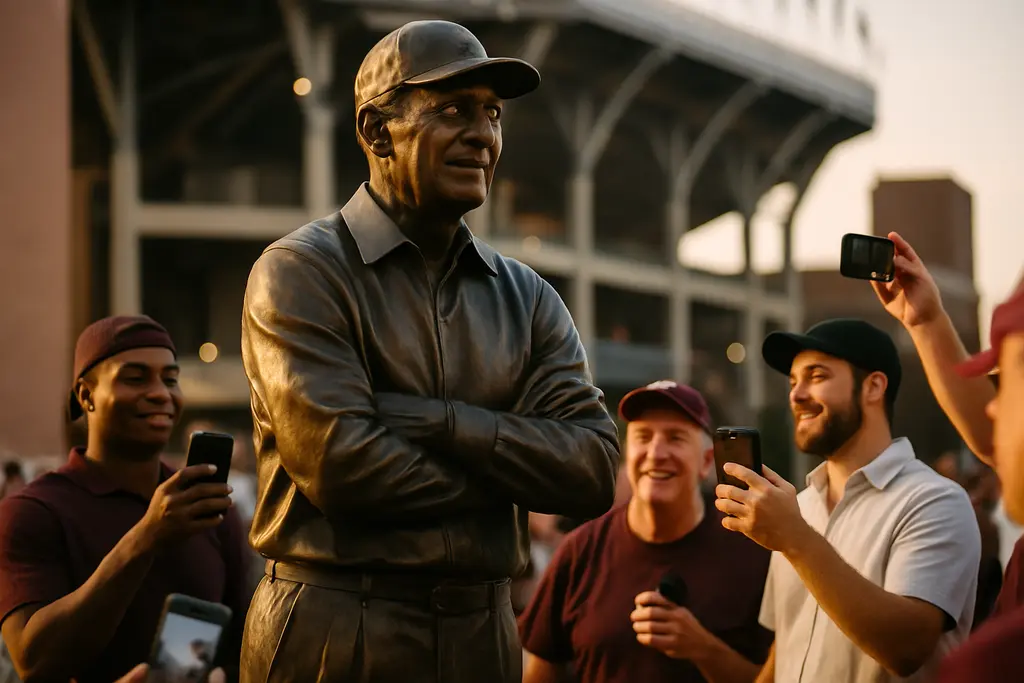

The R.C. Slocum statue did not add a new trophy to Texas A&M’s case. It did something more direct for the program’s public memory. After Texas A&M unveiled it on September 4, 2026, at the north end of Kyle Field in the Zone Plaza near entries 5 and 6, the school gave fans a fixed marker for the coaching standard that shaped modern Aggie expectations Texas A&M announcement.
That matters in College Station because coaching legacies are not abstract. They are measured through conference control, roster development, home-field command and how a program responds when the game tightens. Slocum’s tenure supplied Texas A&M with all four. The statue enhances the school’s legacy because it connects a physical place at Kyle Field with a record of competitive consistency that current players, former players and fans can understand without needing a long speech.
Why The R.C. Slocum Statue Fits Kyle Field
R.C. Slocum Statue Location And Ceremony
The placement is part of the message. A statue near entries 5 and 6 at the Zone Plaza puts the honor in a high-traffic fan area rather than in a closed administrative space. That turns the tribute into part of the game-day route. Families, former students and recruits can pass it before entering a stadium where Slocum’s teams built one of the strongest home records in program history.
The dedication also carried institutional weight. University President Susan Ballabina, Director of Athletics Trev Alberts and other officials delivered remarks, and Slocum spoke at the ceremony. That kind of staging matters because Texas A&M did not frame the honor as nostalgia alone. It treated the coach’s career as a live piece of program identity, connected to the university, the athletic department and the football audience that still measures Aggie teams against his level of steadiness.
The Standard It Puts In Public View
For a program with a large stadium culture, the R.C. Slocum statue gives a name and a face to a standard that can otherwise become too broad. “Toughness” is easy to say. “Consistency” is easy to print on a wall. Slocum’s record gives those words football shape. His Texas A&M teams never posted a losing season during his 14 years as head coach, and that matters as much as any single peak because it speaks to week-to-week program control.
A head coach’s job is not just to call plays or set a depth chart. It is to align recruiting, player development, staff structure and game management so that the same identity shows up in different seasons. Slocum’s teams were not defined by one isolated run. They sustained success across conference races, home stands and roster cycles. That is why any discussion of the broader R.C. Slocum legacy has to start with the repeatability of the results.
The Coaching Profile Behind The Honor
Winning Without Losing Seasons
Slocum remains the winningest head coach in Texas A&M history with a 123-47-2 record across 14 seasons from 1989 through 2002 Sports Reference coaching record. The raw number matters, but the shape of the record matters more from a football perspective. Over a long head coaching tenure, poor staff fits, recruiting misses, quarterback instability or defensive slippage usually produce at least one bottom-out season. Slocum avoided that kind of collapse.
That does not happen by accident. It points to a program that could identify its core strengths and protect them. In practical football terms, that kind of consistency usually shows up in assignment discipline, controlled field position, sound special teams and defensive answers that travel from one opponent to the next. The research record does not require exaggerated claims about scheme. The results themselves show a coach who kept Texas A&M competitive year after year.
Why Conference Control Matters
Slocum led the Aggies to four conference championships: Southwest Conference titles in 1991, 1992 and 1993, then the Big 12 championship in 1998. The 1998 title carried its own weight because Texas A&M beat top-ranked Kansas State 36-33 in the Big 12 Championship. That result gave the program a defining late-game achievement against an elite opponent, the kind of win that lasts because it required more than talent accumulation.
The conference dominance from 1991 through 1994 also explains why the statue resonates. During that stretch, Slocum’s teams went undefeated in conference play and built a 29-game unbeaten streak in Southwest Conference games. In coaching terms, that is the clearest evidence of matchup control. Opponents had repeated chances to adjust, recruit differently and attack weak points. Texas A&M still kept answering.
That is the kind of history a statue can carry without needing to list every score. It turns a coach’s résumé into a public reminder that league play is the core test. Non-conference wins can build rhythm, but conference games expose whether a staff can solve familiar opponents. Slocum’s teams did that for a sustained period.
What The Statue Says About Player Development

NFL Draft Output And Program Identity
The R.C. Slocum statue also points toward player development, not just wins. Slocum coached 64 players who were drafted into the NFL, including eight first-round selections. For Texas A&M, that number matters because it links college success to talent growth. A coach can win with finished products for a short stretch. Sustained draft output suggests a program was identifying players, teaching them, strengthening them and preparing them for higher-level evaluation.
That has a recruiting effect even when the statue is not pitched as recruiting material. Prospects and families understand visible proof. A coach honored at Kyle Field with that many drafted players behind his record represents a developmental path. It tells a player that Texas A&M’s standard has long included preparation beyond Saturdays in College Station.
Home-Field Pressure As A Coaching Tool
Slocum’s home record at Kyle Field was 67-11-1, and his teams produced a 22-game unbeaten home streak from 1996 through 2000. That is not just a crowd stat. A home-field edge becomes real only when the team gives the crowd reasons to affect the game. Defensive stops, clean operation, controlled penalties and fourth-quarter stamina turn stadium noise into pressure. Without execution, noise leaks away.
That is where the statue’s location carries extra force. It sits at the same venue where Slocum’s teams repeatedly turned home games into program statements. Fans walking through the Zone Plaza are not being asked to remember a coach in isolation. They are walking into the building where his teams gave Texas A&M one of its clearest competitive identities.
How The R.C. Slocum Statue Enhances Texas A&M’s Legacy
Slocum’s College Football Hall of Fame induction in 2012 confirmed his national standing, but the Kyle Field honor makes the memory local and daily. The R.C. Slocum statue enhances Texas A&M’s legacy because it brings together the parts of a coaching career that still matter inside an SEC football building: winning, development, conference standards and home-field edge.
The strongest part of the honor is that it does not require myth-making. The record is enough. A 123-win head coach, four conference championships, no losing seasons, major NFL Draft output and elite Kyle Field performance give Texas A&M a clear reason to place Slocum in bronze. The statue is not just about what happened from 1989 through 2002. It gives every future Aggie team a visible standard at the stadium gate, one built on repeatable football habits rather than empty slogans.