
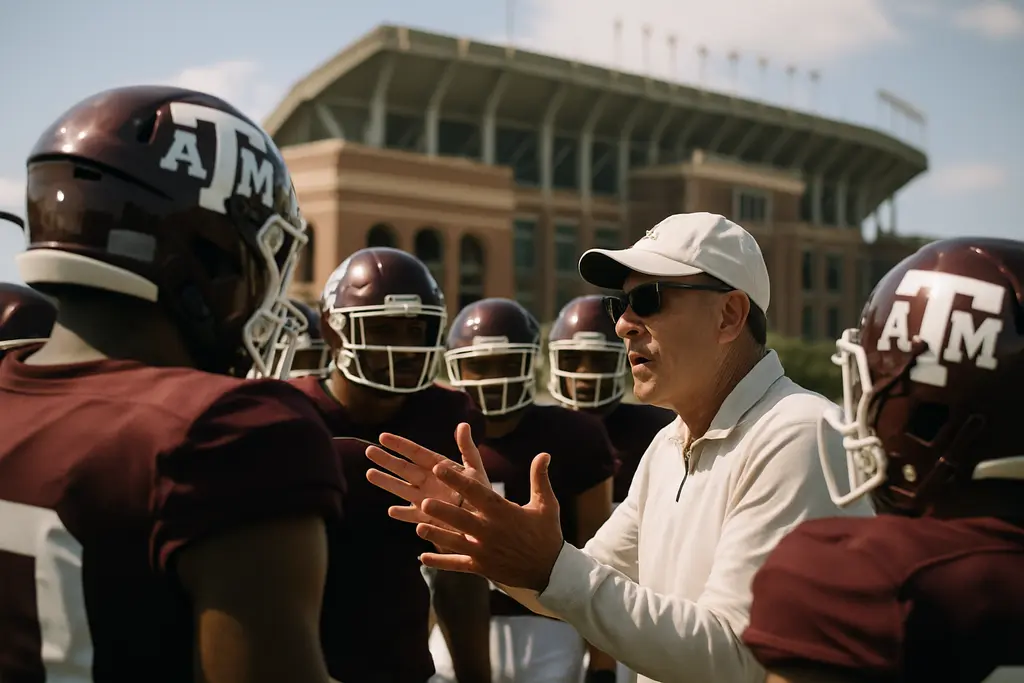

The R.C. Slocum Legacy is not just a bronze statue, a win total, or a familiar name from the Southwest Conference years. For Texas A&M, it is a football case study in how a program can build staying power through defensive structure, home-field command, and a clear coaching identity. Slocum’s tenure is still useful because it gives Aggie fans a hard reference point: what consistent, physical, accountable football looked like across 14 seasons.
Slocum served as Texas A&M’s head coach from 1989 through 2002 and finished 123-47-2, making him the winningest coach in school history, according to his Texas Sports Hall of Fame profile. That record is not a loose memory from a friendlier era. It came with no losing seasons, four conference championships, and a Kyle Field standard that still sits near the center of how Aggies evaluate program strength.
Why The R.C. Slocum Legacy Still Fits Texas A&M
R.C. Slocum Legacy In One Coaching Profile
Slocum’s profile starts with duration. Fourteen seasons is long enough for recruiting cycles, staff changes, injuries, conference movement, and opponent adjustments to test whether a coach has a system or just a hot stretch. His 123 wins, 47 losses, and 2 ties came across that full span. He did not stack one or two strong years on top of a fragile base. He kept Texas A&M in winning position year after year.
The no-losing-season marker matters because it speaks to floor as much as ceiling. In film terms, that is the sign of a team that usually understood down-and-distance, tackled well enough to avoid cheap points, and had enough weekly organization to prevent bad Saturdays from becoming bad months. The record says Slocum’s teams had recovery mechanisms. They could lose a game without losing their identity.
The Baseline Was Competitive Control
That baseline is why comparisons to modern Texas A&M expectations still start with Slocum. The SEC schedule now creates different roster and travel demands than the SWC and Big 12 years did, but the evaluation question has not changed much: can a coach establish a repeatable edge before talent alone becomes the discussion? Slocum’s answer was grounded in defense, special-teams discipline, field position, and a home venue that felt structurally difficult for opponents.
For readers who want the broader season-by-season frame, our deeper look at the Slocum era tracks how those years shaped the modern Texas A&M standard.
The Defensive Standard Behind The Run
Structure Before Slogan
The Wrecking Crew label is often treated as a slogan, but its real value was tactical. Great defensive branding only lasts when the film matches the name. Slocum’s best teams were not built around passive containment. They were associated with pressure, assignment soundness, pursuit, and the kind of leverage that forces offenses to play from behind the sticks.
That is where the R.C. Slocum Legacy carries weight beyond nostalgia. Defensive football at that level is not only about having future pros on the field. It is about forcing an offense to solve the same problems repeatedly: identify pressure, protect the edge, handle interior run fits, and finish drives in compressed space. A defense that can win early downs changes the playbook for the opponent’s coordinator. Third-and-long is not an accident; it is the product of first- and second-down control.
Kyle Field As A Tactical Edge
Texas A&M went 67-11-1 at Kyle Field during Slocum’s head-coaching tenure, a home winning percentage of about .854, according to Texas A&M’s official announcement. That number is one of the cleanest ways to explain the era. Kyle Field was not only loud. It became a place where visiting offenses had to handle communication stress while facing a team that understood how to squeeze mistakes.
Home-field advantage can be overstated if the team on the field lacks answers. Slocum’s Aggies had answers often enough to make the stadium matter. Noise can force a late snap or a missed check, but the defense still has to fit the run, pass off routes, and tackle in space. The home record suggests Texas A&M connected crowd energy to actual execution rather than leaning on atmosphere alone.
Championship Seasons And Program Control
The SWC Sweep
Slocum won three straight Southwest Conference championships in 1991, 1992, and 1993. From 1991 through 1994, Texas A&M went 28-0-1 in SWC play. That run is the kind of conference control that changes how opponents prepare. Teams stop asking whether they can outlast you and start searching for exceptions: a turnover burst, a special-teams play, a weather-aided slowdown, or a quarterback performance outside the scouting report.
Conference dominance usually reflects more than a single unit. It requires recruiting fit, staff continuity, week-to-week practice standards, and enough offensive stability to protect a defense from bad field position. Slocum’s teams were remembered for defense, but those conference records point to program balance. You do not go unbeaten in league play across that kind of stretch by winning one phase only.
The 1998 Big 12 Breakthrough
The 1998 Big 12 Championship gave Slocum’s tenure a defining cross-era result. Texas A&M beat top-ranked Kansas State 36-33 in double overtime on December 5, 1998. That game sits differently from the SWC titles because it showed the Aggies could still produce a championship moment after the conference structure changed.
From a coaching standpoint, that win matters because it required endurance and adjustment. Double overtime strips away some of the comfort of normal game flow. Red-zone answers, situational calls, and emotional control become the whole contest. Slocum’s teams were often described through defensive toughness, but a 36-33 championship win also required enough offensive response to keep the game alive until the final leverage point.
Honors, Statue, And The R.C. Slocum Legacy

What The 2026 Recognition Changed
On September 4, 2026, Texas A&M unveiled a bronze statue honoring Slocum outside the north end of Kyle Field. The placement matters. It ties his name to the building where his teams went 67-11-1 and where the program’s identity is presented every fall Saturday. A statue can flatten a coach into a symbol, but in this case the symbol is backed by a long record of performance.
Slocum’s honors also show how his impact reached beyond local memory. He was inducted into the Texas Sports Hall of Fame in 2005, the Texas A&M Athletics Hall of Fame in 2008, and the College Football Hall of Fame in 2012. On June 9, 2026, he was announced as the recipient of the 2026 Lamar Hunt Lifetime Achievement Award, with the presentation scheduled for Friday, November 13, 2026. Those recognitions do not replace the football record. They help frame why the record still travels well outside College Station.
Why Awards Match The Film
A coaching honor can sometimes feel ceremonial. Slocum’s case is stronger because the film logic matches the résumé. His teams generally played with a clear defensive personality, protected Kyle Field, and kept the program above the losing line for 14 seasons. The bowl record, 3-8 across 11 games, keeps the assessment honest. Slocum’s tenure was not perfect, and postseason results remain part of the file. Still, the longer sample points to stability at a level Texas A&M has spent years trying to match.
What The R.C. Slocum Legacy Means For Texas A&M
The most useful part of the R.C. Slocum Legacy is not that it gives Aggies a comfortable past to revisit. It gives the program a demanding benchmark. Winning at Texas A&M has never been only about recruiting rankings, facility scale, or crowd size. Those pieces help, but Slocum’s tenure showed that a coach has to turn resources into a weekly playing style opponents can feel on tape.
For the current SEC version of Texas A&M, the lesson is direct. Build a defensive structure that travels, make Kyle Field more than a backdrop, and keep the program’s competitive floor high enough that one loss does not fracture the season. Slocum’s best years did that with uncommon consistency. That is why his legacy still belongs in any serious discussion about what Texas A&M football is supposed to look like when it is functioning at a championship level.