
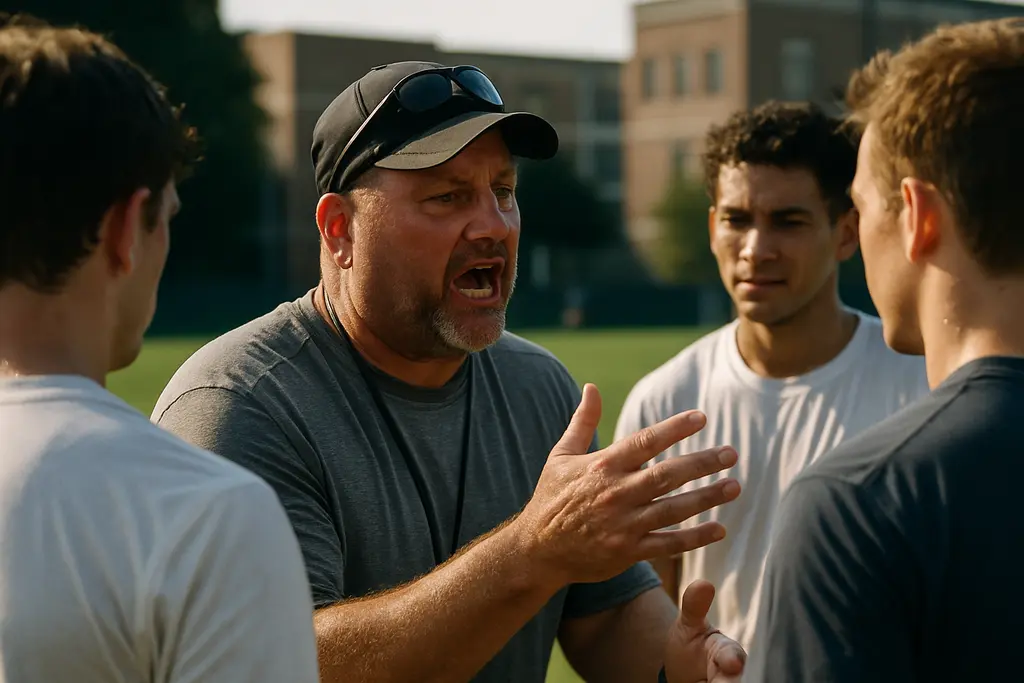

The Mike Elko Strategy for using Texas A&M’s new talent in 2026 is less about handing out jobs and more about forcing the roster to prove what it can handle. That distinction matters in College Station because the Aggies entered September 2026 with returning skill production, a returning quarterback, and a rebuilt offensive line that had to become functional quickly without being treated as fixed on paper.
Elko’s public comments have pointed toward competition as the organizing principle. The roster added transfers in high-stress spots, kept Marcel Reed at quarterback, and returned productive pieces around him. The staff also had to replace proven defensive leaders and rebuild parts of the front. The plan, based on the available reporting and Elko’s own August 2026 comments, reads like a controlled stress test: bring in capable players, keep roles open, and let practice performance determine how much of the system can be carried into SEC play.
Mike Elko Strategy Starts With Competition
Elko’s most revealing comment from his August 4, 2026 fall preview was not about a single player. It was about process. He said Texas A&M was “not bringing in the starting tackle” and instead had “a handful of guys” who could compete to earn that spot, according to Texas A&M’s fall preview quotes. That phrasing shows how the staff wanted to frame transfer additions: not as plug-and-play guarantees, but as competition pieces inside a roster build.
Transfers Are Additions, Not Automatic Answers
The offensive line made that philosophy unavoidable. Texas A&M lost four of five starters up front and added SEC transfer linemen Wilkin Formby from Alabama, Tyree Adams and Coen Echols from LSU, and Trovon Baugh from South Carolina, with Mark Nabou Jr. returning at center, as reported by The Washington Post preview. That is not a minor depth-chart adjustment. It changes how the offense must practice cadence, combination blocks, protection calls, and short-yardage identity.
The staff’s challenge was not simply finding the five best linemen. It was finding the five who communicate best together. A tackle with SEC experience still has to understand how Reed sets protections, how Nabou handles interior calls, and how the backs fit into pressure answers. That is why Elko’s competition language matters. The new linemen gave Texas A&M options. They did not remove the need for chemistry.
Why The Offensive Line Shapes The Menu
The line rebuild also affects play design. With a stable returning quarterback, a staff can carry more volume. With four new starters possible around the center, the staff may have to decide how much volume is worth keeping if it slows down execution. In practice terms, that means choosing between a bigger call sheet and a cleaner one.
That balance is central to the Mike Elko Strategy. Reed’s mobility and experience give the offense answers, but protection rules still set the ceiling for dropback passing, play-action depth, and third-down answers. If the line communicates cleanly, the Aggies can ask more of the passing game. If the unit needs time, the staff can lean into tempo control, defined reads, quarterback movement, and run-pass structures that reduce long-developing stress.
This is also where schedule pressure becomes part of coaching. Texas A&M’s roster answers are not tested in a vacuum, and the program’s road setup has been a major part of the 2026 conversation; our breakdown of Texas A&M’s 2026 road schedule explains why offensive-line communication away from Kyle Field can decide whether talent translates into steady drives.
Receiver Depth Changes The Spacing Math
The clearest skill-position advantage is the number of credible targets around Reed. The Washington Post reported that Texas A&M returned receiver Mario Craver after a 919-yard 2025 season, returned running back Rueben Owens II after 639 rushing yards at 5.4 yards per carry in 2025, and added Alabama transfer Isaiah Horton, who had 511 yards and eight touchdowns in 2025. The same report noted that K.C. Concepcion moved on to the NFL.
Mike Elko Strategy At Receiver
The Mike Elko Strategy at receiver appears to be built around depth before specialization. Elko said on August 4 that Texas A&M had “more depth and talent” at wide receiver than at any point in his time with the program, while also pointing to timing, rhythm, and execution as areas that still needed growth. That is the right concern for a quarterback-driven offense. Receiver depth only changes defensive spacing if the timing is dependable.
Craver’s returning production gives Reed a known reference point. Horton’s 2025 production gives the staff another experienced option. The key is how Holmon Wiggins, promoted internally to offensive coordinator according to the provided research, sequences the passing game without changing too much around Reed. Continuity for the quarterback was a clear reason for that internal move. From a scheme standpoint, that suggests the Aggies wanted to protect Reed’s operating language while still widening the range of personnel groupings.
That can show up in several ways without requiring a dramatic identity shift: more rotation to preserve speed, more formation variation with the same core concepts, and cleaner answers when defenses bracket the first read. The coaching point is simple. New talent does not need a new playbook as much as it needs precise spacing inside the existing one.
New Backs Need Defined Windows
Owens gives the offense an established rushing piece, but the backfield discussion does not stop there. The provided research noted that true freshman KJ Edwards was expected to receive early touches and that Jamarion Morrow had shown flashes in 2025. That type of room calls for defined usage rather than vague rotation.
For a staff, the question is not only who runs hardest. It is who handles protection, motion rules, route spacing, and ball security within each package. Freshmen can earn touches faster when their assignments are narrow and repeatable. A few carries attached to specific formations can create a clean entry point. Expanding those touches depends on whether the player can stay on the field when the defense changes personnel or checks pressure.
That is where Elko’s competition model meets offensive design. If younger backs earn trust in protection, the offense can disguise run and pass from the same personnel. If they are limited to obvious run situations, defenses can tighten the box and reduce the value of the rotation.
Defensive Replacement Is About Roles Not Replication

Texas A&M’s defensive problem in 2026 was not only volume of departures. It was the kind of departures. The Aggies had to replace SEC Defensive Player of the Year Cashius Howell, defensive tackle Albert Regis, multiple-year captain Taurean York, and top cover corner Will Lee III, per The Washington Post. Those losses touch every level: pass rush, interior strength, communication, and coverage reliability.
Pass Rush Must Be Rebuilt By Committee
Anto Saka, a Northwestern transfer, arrived with 12 sacks over three seasons and All-Big Ten honorable mention recognition in 2025. That gives Texas A&M a proven edge profile, but it does not mean one player replaces Howell’s impact. A defense usually replaces a high-end rusher through pressure distribution, not imitation.
For Elko, that likely means using Saka as part of a larger front plan: edge pressure paired with interior movement, simulated pressure looks, and coverage structures that buy an extra half-second. The Aggies do not have to recreate the exact 2025 pass-rush formula to remain sound. They have to build a new one that fits the personnel now taking snaps.
Linebacker And Secondary Stress Points
The provided research identified T.J. Searcy, Marco Jones, and Sam M’Pemba as returning defensive pieces expected to help fill gaps. It also listed Searcy’s first Texas A&M season at 31 tackles, 6.5 tackles for loss, and 1.5 sacks. Those numbers point to activity, but Elko’s defensive structure will depend on assignment discipline as much as playmaking.
Losing a captain at linebacker and a top cover corner can change how aggressive a coordinator feels on early downs. If the second level communicates well, the defense can disguise pressure and rotate coverage later. If the communication is unsettled, the call sheet can shrink. That is the defensive version of the offensive-line issue: talent is necessary, but trust determines how much scheme can be used.
Why Mike Elko Strategy Matters In College Station
The Mike Elko Strategy matters because Texas A&M has the kind of roster that can look strong on a position chart while still needing proof at the contact points. Quarterback continuity, receiver depth, and transfer experience are real assets. So are a returning center and a productive running back. Yet the SEC usually exposes weak communication faster than weak measurables.
That is why Elko’s competition-first language fits this roster. It keeps pressure on transfer linemen who arrived with experience. It keeps young backs from being judged only by recruiting profile. It keeps receivers focused on timing rather than reputation. It also gives the defense a path to replace leadership through shared execution rather than forcing one newcomer to become the direct substitute for a departed star.
For Texas A&M fans, the key coaching story is not whether the Aggies added enough names. They did. The sharper question is whether those names can be organized into dependable down-to-down football. The answer rests in how quickly new linemen communicate, how cleanly Reed and the receivers build rhythm, and how the defense redistributes responsibility after major departures. That is where the 2026 season will show whether the plan is a roster patch or a durable coaching model.