
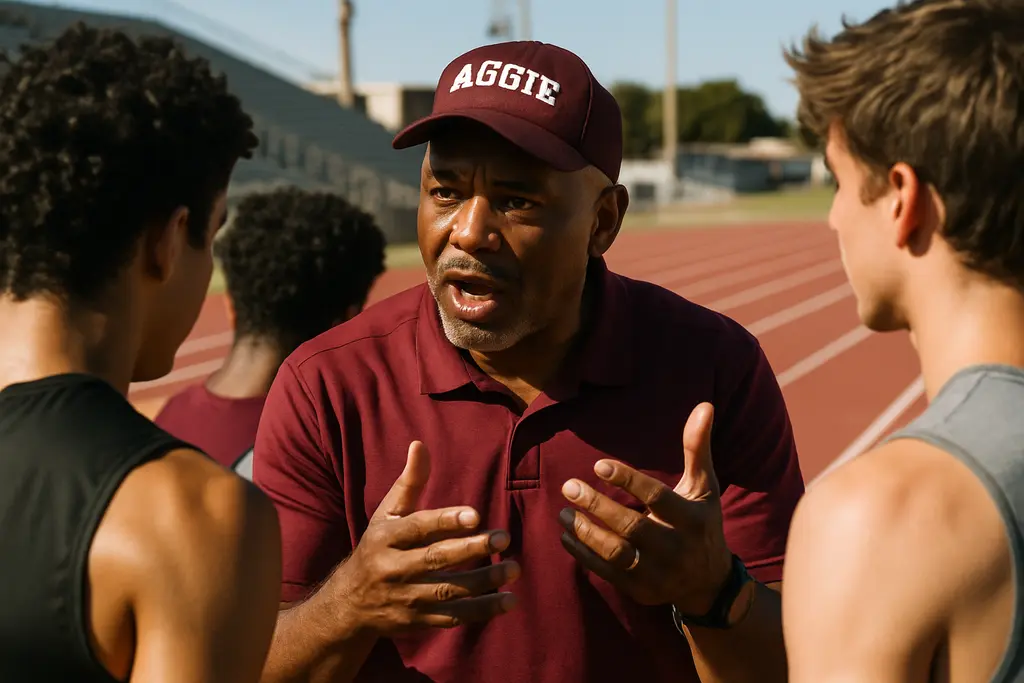

The Leroy Burrell hiring was not a routine coaching change for Texas A&M. On June 28, 2026, the school announced Burrell as the 20th head coach of its track and field program, with the move placing him directly behind Pat Henry in one of the most defined coaching legacies in Aggie athletics official announcement. For a Texas A&M audience trained by SEC football to read every staff decision as a signal, this hire says a great deal about how the athletic department wants to protect identity while updating the operating model around recruiting, NIL, roster retention and athlete development.
Track and field is not football, but the leadership questions travel well. Can a new coach inherit a high-standard room without shrinking under the past? Can he keep the core traits of the program while changing the daily teaching points? Can he recruit elite talent and still sell discipline, academics and institutional fit? Those are familiar questions in College Station, whether the sport is playing Saturdays at Kyle Field or lining up in a 4×100 relay.
Burrell arrived with a profile that fits both halves of that equation. His resume includes world-class sprint credentials, long-term head coaching work at Houston, and recent SEC results at Auburn. Texas A&M did not choose an unknown builder. It chose a coach with evidence in development, speed production and national championship meet scoring. The tactical question now is how those strengths reshape the Aggies without reducing the program to one event group.
Leroy Burrell Hiring And The Aggie Standard
What The Leroy Burrell Hiring Signals
The Leroy Burrell hiring signals continuity first, then adjustment. That order matters. Texas A&M was not taking over a broken operation. The track and field program under Pat Henry had already been defined by national relevance, championship expectations and a broad competitive base. When a program has lived at that level, the wrong transition can create drift: athletes wait to see whether standards soften, recruits look for cracks, and assistants try to read which parts of the old process still matter.
Burrell’s appointment answers part of that pressure because his background is not built on a single season or a single athlete. At Houston, according to the school’s release, he spent 23 seasons at his alma mater and produced 44 conference titles, 19 national champions, 266 All-America honors and 376 conference champions. At Auburn from 2022 through 2026, his teams earned four top-five NCAA Championship finishes, including an outdoor runner-up finish in 2024, third indoors and fourth outdoors in 2025, and fourth indoors in 2026. That track record gives him credibility with athletes who want proof that the daily plan can turn into championship points.
The Pat Henry Shadow
Replacing Henry is not just a staffing task. It is a cultural test. Texas A&M’s athletic identity often leans on toughness, loyalty, visible standards and the idea that one program’s success should raise expectations for the rest of the department. In football terms, this is similar to replacing a coach whose system became part of how fans understood the school. The playbook may change, but the new coach has to respect why the old one worked.
That is where Burrell’s sprint background becomes only part of the story. His athlete resume is rare: world records in the 60 meters, 100 meters, 4×100 meters and 4×200 meters, Olympic gold in the 4×100 relay at the 1992 Barcelona Games, and 100-meter world record runs of 9.90 seconds in June 1991 and 9.85 seconds in 1994. Yet elite personal speed does not automatically make a coach a program leader. The more relevant point is that his coaching record shows repeatable production across stops, which gives Texas A&M a better chance to keep the inherited standard from becoming a museum piece.
How Burrell’s Track Blueprint Travels
Speed As A Program Philosophy
Every coach has a base call. In football, some coordinators want to run inside zone until the defense overcommits. Some defensive coaches build from quarters coverage and force opponents to execute underneath. Burrell’s base identity is speed, especially in the sprint and relay space. That does not mean Texas A&M becomes narrow. It means the program can use speed as a tone-setter, the same way a football staff might build tempo or defensive front play into the entire roster’s personality.
The official release noted that athletes under Burrell broke the collegiate record in the 4×100 outdoors in 2026. It also noted elite hurdle production from Ja’Kobe Tharp, including a 12.75 in the 110-meter hurdles semifinals that broke NCAA and world records. Those are not minor data points. Relay exchanges and hurdles demand speed, timing, rhythm and technical precision under pressure. For an Aggie program trying to stay nationally dangerous, that kind of event profile can create meet-day leverage because a relay group can swing points and energy quickly.
Development Across Events
The risk for any sprint-branded coach is perception. If the room believes the head coach sees only one part of the roster, field events and distance groups can feel like support pieces rather than scoring assets. Burrell addressed that concern in his public messaging after taking the job. At his June 30, 2026 introduction, he spoke about building a well-rounded program, highlighted the 4×100-meter relay, discussed stability amid recruiting and portal pressure, and said the word “student” comes first in “student-athlete” KBTX report.
That phrasing matters because Texas A&M’s identity is not supposed to be a collection of isolated stars. The department sells belonging, standards and a visible connection to the university. A well-rounded track program fits that brand better than a points plan built around one lane of the sport. Burrell’s challenge will be balancing his clearest competitive edge with the broader scoring math required at NCAA meets.
What Changes Inside Program Operations
Roster Pressure, NIL And Staff Design
The Leroy Burrell hiring also reflects the administrative side of modern college sports. The research notes show that after his arrival, Burrell appointed Nate Collins as chief of staff/general manager on July 15, 2026, with duties tied to recruiting, NIL, operations and internal and external program functions. On July 31, 2026, he hired Joe Riccio as throws coach after Riccio’s Auburn group produced nine NCAA qualifiers, four All-Americans and one SEC champion in a single season.
Those moves point to a head coach who understands that training plans are only one part of the job. In 2026, roster management is constant. Athletes have more movement options. NIL conversations affect retention. Recruiting is not limited to high school evaluation. A general manager-style position can help organize the back end so event coaches and athletes are not left guessing about process. That does not guarantee results, but it fits the direction of major college athletics.
Football fans have watched this shift up close. The head coach is still the face of the program, but the strongest staffs often win through infrastructure: player personnel, recruiting calendars, development plans, academic support and clear communication. That same principle applies here. If Burrell’s staff structure reduces noise around the athletes, Texas A&M can keep more attention on training quality and championship preparation. For readers who track leadership arcs across Aggie sports, this hire fits within broader coaching legacy debates at the school.
Character Fit Inside Aggie Athletics
Trev Alberts’ public framing around integrity, tradition and credible leadership was not window dressing. Texas A&M has enough resources to chase famous names, but the department also has to protect the culture it asks athletes to represent. Burrell’s comments about integrity and being a great human being fit that standard. The message was clear enough: the hire was about medals and points, but it was not only about medals and points.
That distinction is central to Aggie identity. A coach can win and still feel misaligned with College Station if the program does not reflect the university’s values. Burrell’s early language suggests he understands that the head coach is teaching more than starts, exchanges and finish-line posture. He is teaching how athletes carry themselves in a program that expects public accountability. That is the connective tissue between track and the football culture many readers know best.
Why The Leroy Burrell Hiring Matters In Aggieland
The Leroy Burrell hiring matters because it gives Texas A&M a succession plan with both proof and purpose. The proof is in his production at Houston and Auburn, his athlete development record, and his own sprint credentials. The purpose is in the way he has described the job: build a balanced team, stabilize the roster environment, compete in speed events that can define meet momentum, and keep the student-athlete idea tied to academic and personal standards.
There is still uncertainty because no transition from a legendary coach can be graded on press conferences or resumes alone. The real evaluation will come through recruiting retention, event-group depth, NCAA meet scoring and how quickly athletes adopt the new staff’s teaching language. What is already supported by the record is that Texas A&M did not make a cosmetic hire. It chose a coach whose background matches the department’s desire to remain nationally relevant while presenting the program as disciplined, fast and aligned with Aggie values.
For a football-centered fan base, that is the part worth tracking. Championship identity is not housed in one stadium or one sport. It is reinforced every time a major Texas A&M program replaces a giant and refuses to lower the bar. Burrell now owns that handoff.