


Texas A&M Recruiting has a verified 2026 headline piece in five-star athlete Brandon Arrington, and the class is being judged against a player-acquisition model shaped by NIL resources, transfer timing and rules pressure. The key question is not whether the Aggies have generated attention. They have. The better question is how much of the reported class strength can be measured with reliable evidence, and where Mike Elko’s staff still has to turn recruiting wins into roster answers.
How Texas A&M Recruiting Built The 2026 Class
The clearest supported data point in the current 2026 cycle is Arrington’s commitment. CBS Sports reported that Texas A&M added five-star athlete Brandon Arrington, a San Diego prospect, to a class it described as top-five nationally at the time of the pledge CBS Sports report. That is a major marker for a staff trying to stack high-end talent in a league where roster quality has to survive a full SEC schedule, not just signing-day grading.
Texas A&M Recruiting And Brandon Arrington
The Arrington pledge gives Texas A&M Recruiting a national-facing win. The research identifies him as a five-star athlete from California, which matters for two reasons. First, it shows A&M can still recruit outside its natural Texas footprint when the board calls for it. Second, an athlete designation often means the staff can sort his long-term role after arrival rather than forcing a projection too early.
That flexibility has value, but it also creates a development question. A five-star athlete is not the same thing as a known two-deep contributor on day one. The staff has to decide whether his best fit is on offense, defense or in a hybrid role once he is in the building. That evaluation process will say a lot about how the Aggies handle premium players in a tighter roster environment.
For more background on how the broader group fits into future depth-chart planning, the site’s 2026 recruiting class outlook tracks the bigger roster questions around College Station.
Class Success Starts With Verified Impact
Recruiting rankings are useful as a starting point, but the available approved source set for this review directly supports only part of the larger class profile. The research notes cite national top-10 rankings, a blue-chip-heavy group and a large commit total, but those figures are not backed here by the approved high-authority links. That does not mean they are wrong. It means they should be treated as class context rather than final proof.
The verified success is narrower and still meaningful: A&M landed an elite national prospect and did so in a cycle where spending, retention and rule changes are part of the same conversation. That is enough to say the class has momentum. It is not enough to say the class has solved every personnel issue.
What Is Verified In The 2026 Class
The strongest evidence falls into two buckets: the Arrington commitment and the NIL profile surrounding the Aggies’ 2026 push. Sports Illustrated reported that Texas A&M is among the biggest NIL spenders in the 2026 recruiting class Sports Illustrated report. That fact fits the current direction of major college football, where roster construction now includes high school evaluation, retention plans and financial competition for players who may have several credible options.
For A&M, the NIL note is not just a money story. It is a roster-management story. A program can spend aggressively and still miss if it signs players without a clear development plan. It can also spend well and create roster balance if the staff targets premium traits, protects position depth and avoids overloading one area while leaving another exposed.
- Verified recruiting headline: Arrington’s five-star commitment gives the Aggies a nationally visible win.
- Verified market context: A&M is reported among the largest NIL spenders for the 2026 cycle.
- Unsettled class measurement: Broader ranking, commit-count and blue-chip figures in the research need stronger sourcing before being treated as final.
The distinction matters because fans often judge classes by a single national number. Coaches judge them by whether the signing group fills needs, raises practice competition and produces starters by the second or third season. A class can look strong in December and still require portal help by spring. A class can rank outside the top tier and still hit if the staff identifies the right body types and developmental fits.
Legislative Pressure Around Roster Building
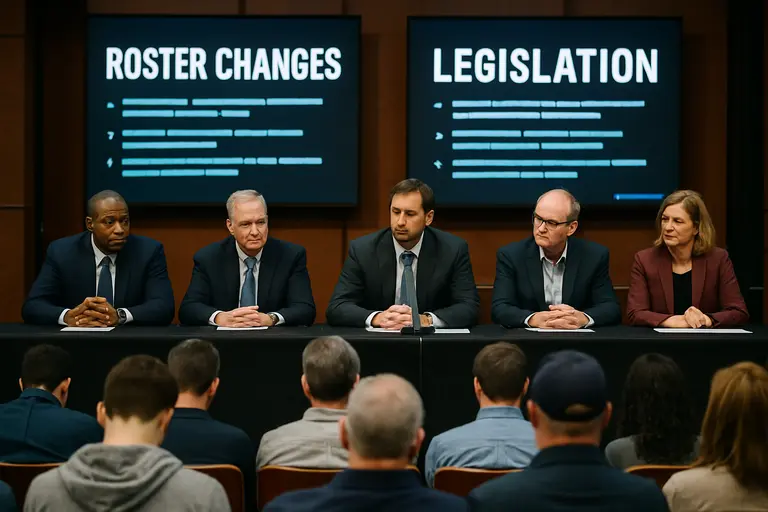
The research for this topic references legislative changes affecting college athletics, but it does not identify a specific statute, effective date, roster limit, enforcement process or compensation rule. That limits the certainty of any direct claim. What can be said is that Texas A&M is operating in a period where NIL activity and roster movement are central to how major programs build teams.
Texas A&M Recruiting And Legislative Pressure
The practical effect is that the Aggies cannot evaluate high school players in isolation. Every prep commitment now has to be viewed next to retention needs, portal depth and the possibility that rules on athlete compensation or roster structure could change again. The staff has to know which players are worth early investment, which positions can be supplemented later and which recruits need a longer development window.
That is where the Arrington commitment carries extra weight. Elite prospects give a program more options. If a player has enough athletic range to fit multiple roles, the staff can respond to roster changes without starting over at a position. That kind of flexibility is especially useful when legislative pressure and NIL policy can affect how many players stay, how many leave and how quickly a team has to replace them.
The program’s approach to rules pressure has been a recurring theme. For related context on how evaluation and timing can shift under new college-football rules, this site has covered how A&M recruiting adjusts to new rules in College Station.
Why NIL Spending Is Not A Standalone Grade
NIL spending can help secure visits, commitments and retention, but it does not guarantee position fit. The Aggies still have to turn resources into useful depth. That means identifying players who can handle SEC line play, special-teams work, travel demands and the weekly physical cost of the league.
It also means avoiding short-term class inflation. A high-profile recruit can lift perception, but class success is measured later by snaps, starts, all-conference development and whether the roster has enough reliable players in November. A&M’s spending profile gives the staff a chance to compete for premium talent. The proof comes when that talent survives the practice field and earns roles.
What Texas A&M Must Prove With The 2026 Class
Texas A&M Recruiting now has to move from acquisition to conversion. The supported facts show a program with a major five-star addition and the financial posture to compete in the 2026 cycle. That is a strong starting point. It is not a finished evaluation.
The next layer is fit. Arrington’s role has to become clear. Any broader class strength cited in outside discussions needs to show up through balanced position groups. NIL investment has to support retention as much as initial commitments. Legislative uncertainty has to be managed without creating a scattered roster plan.
For Aggies fans, the fair grade today is cautious but positive. A&M has verified high-end traction, and the staff appears willing to compete in the parts of modern recruiting that decide SEC rosters. The full grade will come later, when the 2026 class is measured against depth-chart needs, player development and the weekly demands of the league.