
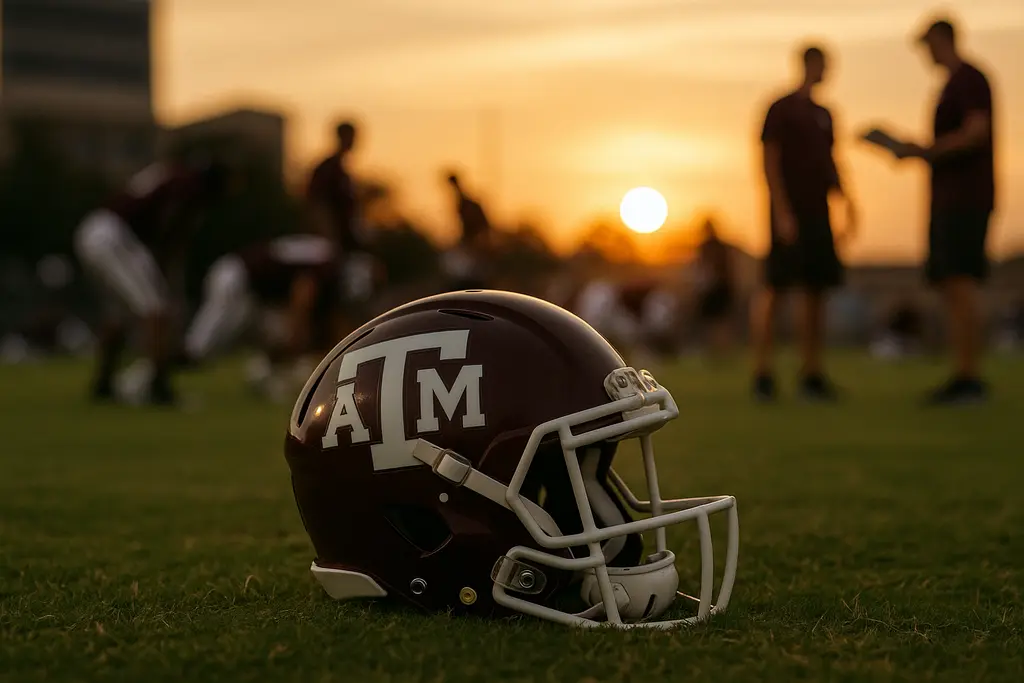

Texas A&M Fall Camp opened Aug. 1, 2026, in College Station, giving the Aggies their first extended camp window to sort through several roster questions before the season, according to Houston.com camp dates. The most direct competitions sit at running back, linebacker and wide receiver, where production, health and role definition will shape how Mike Elko’s team builds its early-season identity.
This camp is not just about finding starters. It is about defining usage. Texas A&M has returning production in several places, but the offense and defense both need answers on how snaps are distributed when the SEC schedule begins to lean on every position group. The running back room has to replace NFL departures while elevating a proven returner. The linebacker group has to account for a spring injury to a senior producer. The receiver room has more bodies to evaluate, but camp must separate situational roles from every-down jobs.
Texas A&M Fall Camp Opens In College Station
What Texas A&M Fall Camp Can Settle
The value of camp is in repetition. Coaches can test pass protection, tackling angles, receiver timing and special teams readiness without making a public depth chart declaration too early. For Texas A&M, the competitions that matter most are not isolated from each other. The running back rotation affects quarterback protection and short-yardage calls. The linebacker battle affects communication in the middle of the defense. The receiver rotation affects how much stress the offense can put on opposing secondaries.
The first task of Texas A&M Fall Camp is to separate readiness from projection. Young players can flash in spring or in individual periods, but camp brings longer practice stretches and more chances to evaluate assignments. That matters for a roster with freshmen, redshirt freshmen and transfers competing against returners who already understand the pace of the program.
Why The First Practices Carry Weight
Early camp practices do not settle every job, but they set the order of evaluation. A player who handles installation, stays available and limits mental errors often earns more chances with the top units. That is especially relevant at positions where Texas A&M has multiple candidates with different profiles. The staff has to decide not just who has the best ceiling, but who can be trusted in the first month of the season.
That creates a practical camp question: which players can stay on the field for all three downs? At running back, that means carrying the ball, protecting the passer and handling receiving duties. At linebacker, it means fitting the run, carrying coverage rules and making checks. At receiver, it means beating coverage, blocking on the perimeter and earning trust on timing routes.
Running Back Rotation Takes Center Stage
Rueben Owens II Moves Into A Larger Role
The running back room is the clearest starting point. Le’Von Moss and EJ Smith departed for the NFL after combining for 609 rushing yards and 10 touchdowns in 2025, while Rueben Owens II led the team with 639 rushing yards and five touchdowns last season, according to SI’s position battle report. That combination of lost snaps and returning production puts Owens in position to carry a larger share of the offense if he proves steady through camp.
Owens already gives the staff a known option. The bigger question is how much volume he can take and how the staff builds the rest of the room around him. A lead back in the SEC rarely works alone for a full season. The Aggies need a second and third option who can keep the offense on schedule, especially in games where the line is still settling or the passing game needs balance.
The Young Backs Have A Real Opening
Jamarion Morrow is expected to have a larger role, while redshirt freshman Tiger Riden and true freshmen KJ Edwards and Carsyn Baker are competing for playing time. That is a wide range of experience in one room, and it makes camp reps valuable. Coaches will be watching who runs with patience, who finishes through contact and who protects the ball when practice intensity rises.
The competition is also about offensive flexibility. If one of the younger backs can handle pass protection and perimeter touches, the staff gains more personnel options. If the gap behind Owens remains wide, the offense may lean harder on a smaller rotation. Either path affects game planning, tempo and how Texas A&M protects its quarterback during the early part of the season.
Linebacker And Receiver Battles Shape The Middle
Linebacker Depth Is Under Review
Linebacker is the defensive battle with the most direct spring-to-camp storyline. Senior Daymion Sanford was injured during the Maroon and White game after recording 57 tackles, 9.5 tackles for loss and 3.5 sacks in 2025. Sophomore Noah Mikhail, who had 16 tackles and 2.5 tackles for loss last season, and junior Jordan Lockhart are among the candidates tied to the open work in the middle of the defense.
Sanford’s production is not a small item to replace. Tackles for loss and sacks from a linebacker point to a player who affected more than routine stops. If he is limited, the staff has to identify who can make the calls, handle motion, fit the run and avoid coverage busts. Mikhail’s returning production gives him a baseline. Lockhart’s camp work will be judged by consistency and whether he can close the gap between assignment and execution.
Receiver Roles Need Definition
At wide receiver, Mario Craver returns and Alabama transfer Isaiah Horton joins the room. Ashton Bethel-Roman is listed as a strong candidate for the third receiver spot, while Terry Bussey, true freshman Aaron Gregory and redshirt freshman Jerome Myles are also competing for roles. That group gives Texas A&M options, but options only help if roles are clear by game week.
The third receiver battle matters because it can determine how the Aggies build formations. A reliable third option can help the offense stay in three-receiver looks without losing blocking strength or route discipline. A young receiver who earns trust can also change how defenses match up on passing downs. The staff does not need every receiver to do the same job. It needs enough defined jobs to avoid guessing once the season starts.
Why Texas A&M Fall Camp Battles Matter For 2026
Roster Answers Will Shape The Early Plan
Texas A&M Fall Camp will not decide the full season, but it can decide how comfortable the staff feels with its early plan. A clear running back rotation would let the offense manage carries and protect against overuse. A settled linebacker picture would help the defense communicate cleanly. A defined receiver rotation would give the passing game more structure and give the quarterback a better sense of where the ball should go under pressure.
The stakes are practical, not abstract. If the Aggies identify trustworthy players in these spots, they can enter game preparation with fewer moving pieces. If the battles remain tight, the staff may use the first games to keep testing combinations. That is common in college football, but it carries more risk in the SEC, where one missed fit or one failed protection can change a possession.
For Texas A&M fans tracking camp from College Station and across the state, the most useful signals will be role-based. Watch which backs are trusted on passing downs, which linebackers are mentioned for communication and which receivers work beyond a single package. Those details will say more about the 2026 Aggies than any early label on a depth chart.