
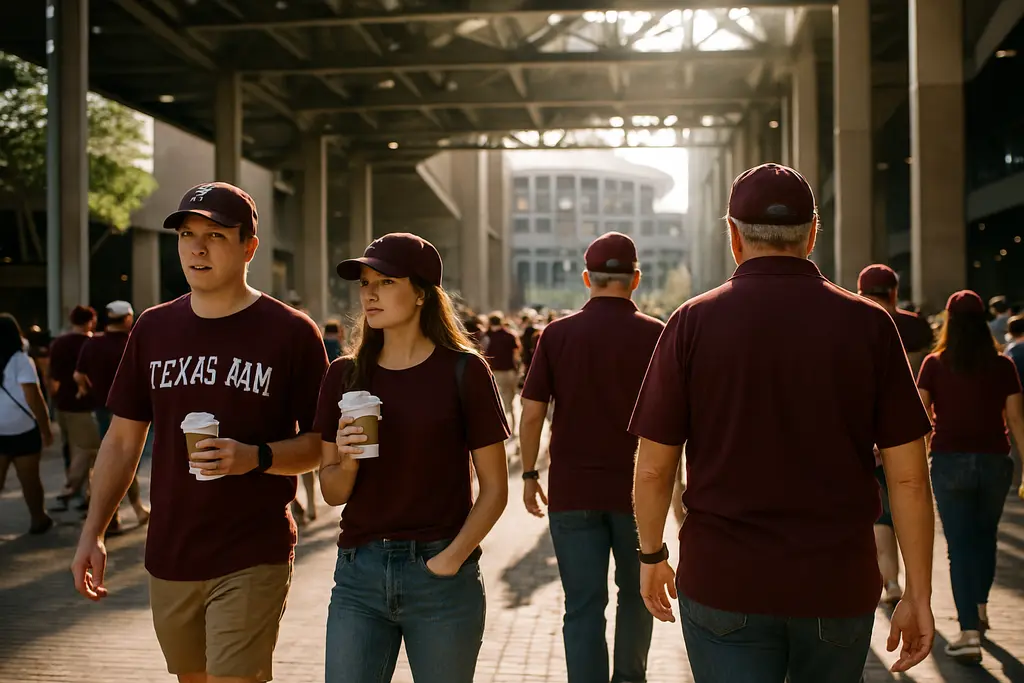

The Kyle Field Pedestrian Passageway has given Texas A&M a defined walking route through the basement level of West Campus Garage, a practical change aimed at moving fans between Olsen Boulevard and Pickard Pass during large events. The route opened for Fall 2026 home football games and is intended to pull foot traffic away from vehicle lanes around John Kimbrough Boulevard, according to Texas A&M Transportation Services’ West Campus Garage project page.
For Aggies fans, the change is less about a new shortcut and more about separation. Kyle Field Saturdays create a hard mix of pedestrians, buses, private vehicles, rideshare movement and garage traffic in a compact part of campus. A dedicated path through WCG gives game-day operations a cleaner way to route people without asking them to share the same points of conflict with exiting vehicles.
What Changed At West Campus Garage
Kyle Field Pedestrian Passageway Basics
The route runs through the basement level of West Campus Garage and links Olsen Boulevard with Pickard Pass. Transportation Services said it uses two entrances: a new northwest corner entrance and an expanded northeast entrance. The plaza near Pickard Pass was also reconfigured to improve movement as fans approach and leave the stadium area.
The Kyle Field Pedestrian Passageway is not a daily garage feature. It is activated only during large events, including home football games. That distinction matters because WCG still functions as a parking facility outside event windows. Texas A&M has also told vehicles parked in Level B1, Row L to relocate before event days so the pathway can operate through that level.
Event-Only Access And Garage Impacts
The event-only setup gives Transportation Services flexibility without permanently changing the garage’s normal use. On game days, the basement-level route becomes part of the stadium access plan. On non-event days, the same space returns to its parking purpose. That approach limits disruption for permit holders while creating extra pedestrian capacity when Kyle Field demand is highest.
There is still a planning point for fans who use WCG. Anyone assigned to or parked near the affected B1 area has to account for relocation instructions before large events. That is a small but real tradeoff: the garage gives up a portion of normal parking function to create a more predictable pedestrian route when the campus population swells.
How The Route Changes Fan Movement
Separation From John Kimbrough Traffic
The clearest benefit is removing walkers from vehicle entry and exit lanes along John Kimbrough Boulevard. That area has long been one of the more sensitive pieces of the game-day footprint because it sits near parking, stadium access and west campus movement. By shifting pedestrians into a controlled interior route, Texas A&M reduces the number of fans crossing or walking near active vehicle paths.
This is a safety-first adjustment, but it also has operational value. Drivers leaving WCG after a game should face fewer interruptions from cross-traffic if more pedestrians use the designated route. The university has described shorter vehicle exit times from WCG after large events as one purpose of the project. No public source in the provided research gives a measured before-and-after exit time, so the supported assessment is about the intended operational benefit rather than a confirmed time savings.
Pressure Around 100,000-Plus Crowds
The scale explains the need. For the Sept. 5, 2026 season opener against Missouri State, Texas A&M anticipated more than 100,000 people at Kyle Field, according to its game-day transportation advisory, which also outlined road closures and no-wheels restrictions before the opener. That kind of crowd turns minor bottlenecks into major delays, especially near garage exits and stadium approach points.
For Texas A&M, the Kyle Field Pedestrian Passageway fits a basic stadium-management principle: separate movements that do not belong together. Fans on foot move at a different pace than vehicles. Families, students, older fans and visiting supporters also pause, gather and change direction in ways cars cannot. A designated route gives staff a clearer way to direct that movement before and after kickoff.
- Pedestrian benefit: a defined path between Olsen Boulevard and Pickard Pass during large events.
- Driver benefit: fewer pedestrian conflicts around WCG entry and exit lanes.
- Operations benefit: a route that can be activated for event traffic and deactivated for normal garage use.
Where It Fits In Game-Day Operations
Timing With Road Closures
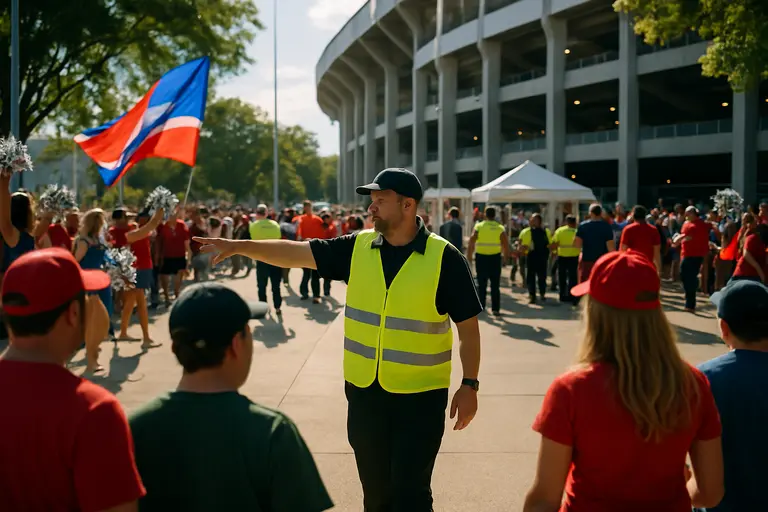
The pathway does not stand alone. Texas A&M’s 2026 game-day advisory said pregame road closures begin 4.5 hours before kickoff, or at 7:30 a.m. for morning games. No Wheels Zones, which restrict bicycles, scooters and similar devices, begin 3.5 hours before kickoff and continue until one hour after the game.
Those timing rules support the same objective as the garage route: simplify movement near Kyle Field before density peaks. The more predictable the street and sidewalk environment becomes, the easier it is for police, transportation staff and event workers to keep fans moving. The Kyle Field Pedestrian Passageway adds one more controlled piece to that plan on the west side of the stadium.
Exit Flow For WCG Drivers
Postgame movement is usually the tougher test. Pregame arrivals are spread across tailgating, Corps activities, student entry and different parking habits. After the final whistle, thousands of people leave in a tighter window. That is when separating foot traffic from WCG vehicle exits should matter most.
The passage through the garage basement gives staff a way to encourage fans to stay off lanes that drivers need to clear. It also helps define where pedestrians should go rather than leaving them to find the closest open gap. For readers tracking broader Kyle Field access changes, the same-site breakdown of Kyle Field passageway changes adds more game-day context around the WCG route.
Why Kyle Field Pedestrian Passageway Matters
Practical Test For Aggie Saturdays
The Kyle Field Pedestrian Passageway matters because it addresses a real pinch point without making unsupported promises. The project gives pedestrians a dedicated route, changes how WCG handles a portion of its basement level during large events, and aims to reduce vehicle-pedestrian conflict near John Kimbrough Boulevard. Those are clear, verified benefits.
The remaining question is performance over a full home schedule. The available official information does not provide fan survey data, crash reduction figures or measured exit-time improvements through Oct. 22, 2026. For now, the strongest assessment is that Texas A&M has added a targeted piece of infrastructure in the right location: between a major garage, a heavy walking corridor and one of the busiest stadium zones in the SEC.
That is the practical value for Aggies fans. Better game-day flow usually comes from smaller fixes that remove friction at the worst spots. At West Campus Garage, this passageway gives Texas A&M a more orderly way to move people and vehicles through the same high-demand space.