
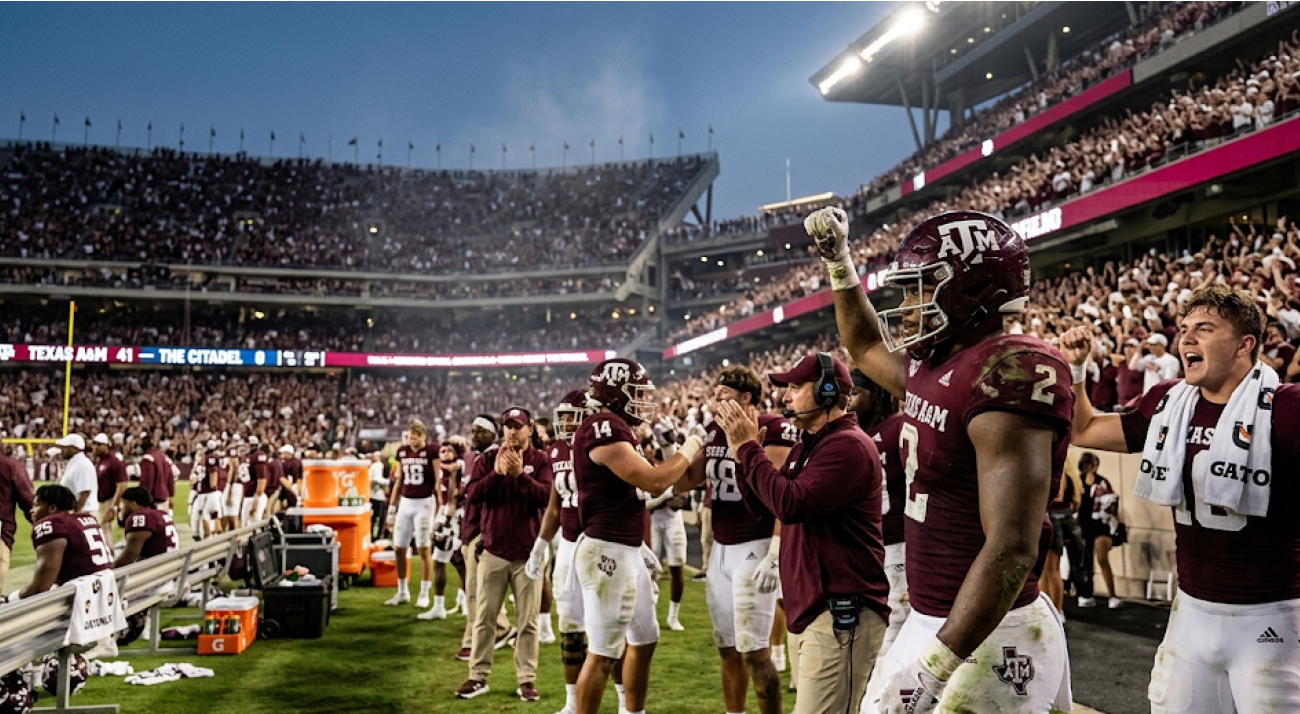

Texas A&M football delivered one of its most convincing performances of the 2026 season on October 17, shutting out The Citadel 41–0 at Kyle Field in College Station, Texas. The victory gave head coach Mike Elko’s team a chance to regroup after a difficult stretch in Southeastern Conference play, while several young offensive players made a strong case for larger roles as the schedule intensifies. As fans look ahead to the Aggies’ next SEC matchup, some may also consult the best Texas sports betting sites for information on available sportsbooks and Texas-specific betting regulations.
The Aggies finished with 501 total yards, including 264 rushing yards and 237 passing yards. Running back KJ Edwards led the ground attack, while Jamarion Morrow scored three rushing touchdowns before halftime. The defense also held The Citadel to 183 total yards, producing a second shutout of the season.
The result was important for a team that entered the game at 3–3 overall and 1–3 in SEC competition. Texas A&M improved to 4–3 with the win, but the bigger test comes next: a road matchup against the Alabama Crimson Tide on October 24.
The question is whether the performance against The Citadel signals meaningful improvement or simply reflects the difference in competition. The answer will become clearer when the Aggies return to conference play in Tuscaloosa.
Texas A&M’s Offense Finds Its Rhythm Against The Citadel
The Aggies established control early and maintained it throughout the afternoon. Their 41-point performance was supported by a productive running game, efficient quarterback play, and a balanced contribution from the offense’s younger players.
Texas A&M scored seven points in the first quarter, followed by 21 in the second. That second-quarter surge gave the Aggies a 28–0 halftime lead and allowed Elko to distribute playing time during the second half. The team added six points in the third quarter and seven more in the fourth.
The scoring distribution matters because Texas A&M did not depend on a single explosive play to build its advantage. The Aggies sustained drives, ran effectively in short-yardage situations, and connected through the air when The Citadel attempted to contain the ground game.
That combination offers a useful foundation for the remaining schedule. SEC opponents will demand greater precision and will have more defensive talent available to challenge Texas A&M’s offensive line, running backs, and quarterback. Still, the performance demonstrated that the Aggies can produce a consistent scoring threat when their principal offensive elements work together.
The next step is maintaining that efficiency against a defense capable of disrupting early-down runs and forcing more difficult passing situations.
KJ Edwards Leads a Productive Texas A&M Running Game
Edwards emerged as one of the standout performers against The Citadel, providing explosive runs and helping Texas A&M control possession through its ground attack. The official SEC recap credited him with 116 rushing yards.
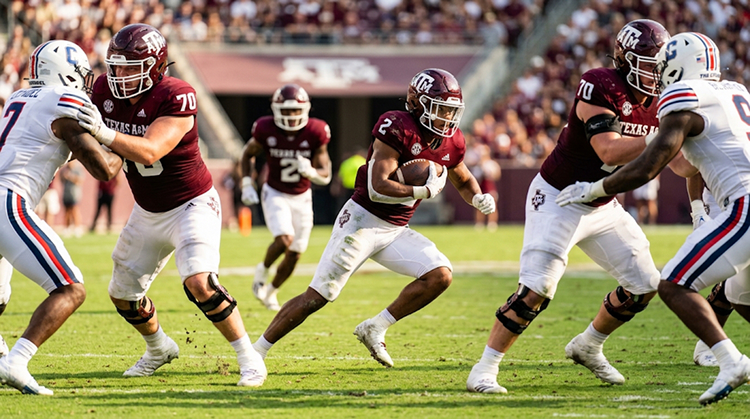
Edwards’ performance was among the most encouraging developments of the afternoon. His rushing production gave the Aggies a reliable way to advance the ball, reduce pressure on the passing game, and sustain drives without needing to rely exclusively on quarterback Marcel Reed.
A productive running game can become particularly valuable during the SEC schedule. Road games often bring hostile crowds, challenging defensive fronts, and situations in which an offense must move the chains without taking unnecessary risks. A back capable of generating consistent yardage can help keep an offense on schedule and make play-action opportunities more effective.
Edwards also gives the coaching staff another option when evaluating the distribution of carries across the running back room. His performance does not automatically establish a permanent change in the depth chart, but it strengthens his case for continued opportunities.
The challenge will be reproducing that output against stronger defensive competition. Alabama will provide a more demanding test of Texas A&M’s blocking, rushing lanes, and ability to create yards after contact.
Jamarion Morrow
Morrow delivered a career-best scoring performance, recording three rushing touchdowns on eight carries for 54 yards. All three scores came in the first half, helping Texas A&M establish a commanding lead.
Morrow’s contribution gave Texas A&M a second major storyline beyond Edwards’ rushing yardage. The sophomore running back entered the game with limited touchdown production earlier in the season, making his performance a potentially valuable development for the coaching staff.
His scores also demonstrated the importance of execution near the goal line. Texas A&M converted short-yardage opportunities into touchdowns instead of settling for field goals, allowing the offense to build its lead quickly. That ability can make a difference in closer conference games, where a single red-zone possession may determine the outcome.
The performance does not guarantee that Morrow will score at the same rate in future games. Defenses will adjust, and the opportunities available to individual backs will depend on the opponent, game situation, and health of the roster. However, his showing gives Elko another option to consider when assembling offensive packages.
For Texas A&M, the ideal outcome is a backfield in which Edwards can provide sustained rushing production while Morrow contributes in scoring situations and complementary roles. If both players remain productive, the Aggies could reduce the burden on Reed and make their offense less predictable.
Marcel Reed and Brady Hart Provide Different Looks at Quarterback
Quarterback performance will remain central to Texas A&M’s ability to compete against SEC opponents. Against The Citadel, Marcel Reed started and completed eight of 13 passes for 130 yards and one touchdown. Brady Hart played in the second half, completing eight of 12 attempts for 107 yards and another passing touchdown.
Reed’s connection with wide receiver Aaron Gregory produced a 37-yard touchdown in the second quarter. Hart later connected with Gregory for a 12-yard score in the fourth, showing that Texas A&M could continue generating points after the starting quarterback left the game.
The coaching staff’s use of Hart gave younger players valuable experience in a game that was largely decided by halftime. That experience could become useful later in the season, particularly if the Aggies need to adapt to changing game conditions.
However, the quarterback statistics require context. The Citadel did not present the same defensive challenge Texas A&M will face against Alabama. Reed and Hart will encounter tighter coverage, more pressure, and fewer opportunities for comfortable throws against a high-level SEC defense.
The priority for Reed remains consistency: protecting the football, recognizing defensive adjustments, and keeping the offense productive on third down. Texas A&M’s rushing attack can support those objectives, but the Aggies will need their passing game to contribute when opponents commit additional defenders to stopping the run.
For readers following the team’s quarterback development, the official Texas A&M football schedule and game coverage provides a useful reference for evaluating the team’s performances as the season progresses.
A Defensive Shutout Offers Encouragement, but the Next Test Is Harder
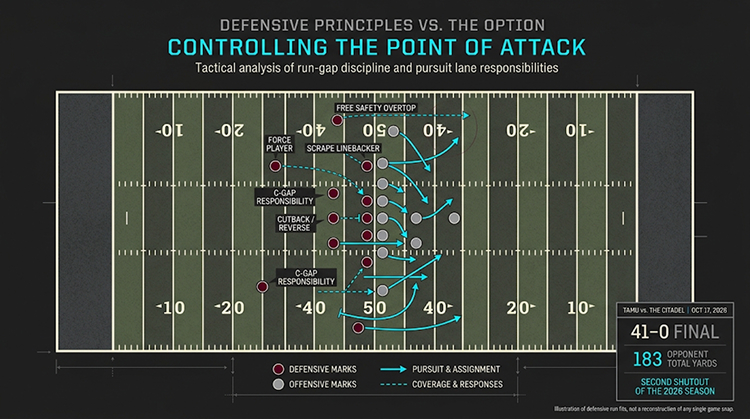
Texas A&M’s defensive performance was just as important as the offensive scoring total. The Aggies limited The Citadel to 183 total yards and prevented the Bulldogs from scoring in all four quarters. It was Texas A&M’s second shutout of the 2026 season, and the program recorded multiple shutout victories in a season for the first time since 1993.
Holding an opponent scoreless requires more than one productive unit. The defense must limit explosive plays, tackle effectively, protect the end zone, and avoid giving away easy yards through penalties or missed assignments. Against The Citadel, Texas A&M maintained control and prevented the Bulldogs from converting their possessions into points.
The matchup also required the Aggies to prepare for The Citadel’s option-oriented offense, which differs from the spread formations and passing concepts common across much of the SEC. Defending an option attack demands discipline from defensive linemen and linebackers, particularly when deciding whether to pursue the quarterback, running back, or pitch player.
Ray Coney recorded seven tackles in the first half, matching his season high, while safety Tawfiq Byard also finished with seven tackles and led the defense with 1.5 tackles for loss. Those contributions helped Texas A&M control the contest.
The result should be treated as a positive performance rather than proof that every defensive concern has been resolved. Alabama’s offense presents a different set of challenges, including more speed, greater depth, and the ability to exploit mistakes in coverage or run fits.
The most meaningful measure of progress will be whether Texas A&M can sustain its tackling, discipline, and communication against an opponent capable of turning small defensive errors into significant gains.
Texas A&M Must Address Receiving Depth Before the Alabama Game
The shutout did not erase every question surrounding the Aggies’ offense. Wide receivers Mario Craver and Ashton Bethel-Roman were absent against The Citadel, according to reporting by the Houston Chronicle. Their availability and the performance of the remaining receivers are important considerations as Texas A&M prepares for a more demanding opponent.
Aaron Gregory provided a bright spot, catching the 37-yard touchdown from Reed and the 12-yard touchdown from Hart. His production demonstrated the value of having receivers capable of making plays with different quarterbacks under center.
Texas A&M will need that depth if Alabama pressures Reed and limits the time available to throw. A productive running game can force defensive adjustments, but receivers must capitalize when those adjustments leave openings downfield or create favorable one-on-one matchups.
The coaching staff must also balance player availability with offensive continuity. If injured receivers return, the Aggies will need to reintegrate them without disrupting the progress of players who have taken advantage of recent opportunities. If they remain unavailable, the remaining receiving group must be prepared for a larger workload.
The team’s performance against The Citadel offers some encouragement, but the next game will provide a much clearer indication of whether its passing attack can remain effective against an SEC opponent.
Texas A&M at Alabama
The trip to Tuscaloosa is the most immediate measure of whether the win over The Citadel can translate into conference success. Alabama offers a different level of competition and will test the Aggies in areas that were not fully challenged during their home victory.
Texas A&M’s first priority should be establishing the run without becoming predictable. Edwards and Morrow give the offense options, but the offensive line must create opportunities against Alabama’s defensive front. If the Aggies can produce consistent early-down gains, Reed may have more manageable passing situations.
The second priority is protecting the quarterback. Texas A&M cannot afford repeated negative plays that force long third downs and allow Alabama to dictate the defensive approach. Efficient passing, sound decisions, and timely throws to available receivers will be essential.
Defensively, the Aggies must prevent Alabama from controlling possession and generating momentum through explosive plays. The shutout against The Citadel demonstrated sound execution in that matchup, but Alabama’s offensive personnel will require sharper communication and a different defensive plan.
Texas A&M also needs to manage the emotional side of a road game. A strong start could help the Aggies establish confidence, while early mistakes could quickly place pressure on an offense still working to build consistency.
The historical matchup adds another layer of interest. Texas A&M defeated Alabama 41–38 in 2021, while the Crimson Tide won 24–20 in their most recent meeting in Tuscaloosa in 2022. The Aggies will be looking for another important road result against one of the SEC’s established programs.
Fans can consult the official Alabama football game center for the scheduled matchup details.
What the Aggies Need to Carry Forward From the 41–0 Win
Texas A&M’s victory provides several clear areas to build on, but sustained improvement will depend on repeating those performances against stronger competition.
First, the Aggies need to maintain their rushing efficiency. Edwards’ yardage and Morrow’s scoring production showed how an effective backfield can influence a game. Continued production from both players would give Reed more flexibility and help the offense avoid becoming one-dimensional.
Second, the defense must maintain its discipline. The Citadel game rewarded sound execution against an option-oriented attack. The Alabama matchup will require the same attention to assignments, but with a greater emphasis on coverage, pass rush, and limiting explosive plays.
Third, the receiving group must be ready for changing personnel. Gregory’s two touchdown receptions were encouraging, but Texas A&M needs reliable production across the lineup, particularly if Craver or Bethel-Roman cannot return immediately.
Finally, the coaching staff must turn the performance into a repeatable standard. One convincing victory can restore confidence, but it does not resolve every problem from a season that has already included difficult conference results. The Aggies entered the Citadel game at 1–3 in SEC play, making each remaining conference matchup increasingly important.
A competitive performance in Tuscaloosa would provide stronger evidence that Texas A&M is making progress. A victory would be even more significant, improving the team’s conference position and changing the conversation around its season.
Can Texas A&M Turn This Win Into a Season-Defining Run?
The 41–0 victory over The Citadel gave Texas A&M a much-needed positive result, highlighted promising performances from KJ Edwards and Jamarion Morrow, and showed that the defense can deliver a complete performance in the right matchup.
Yet the Aggies’ season will be judged by what happens against SEC competition. The Alabama game on October 24 offers an immediate opportunity to demonstrate that the progress seen at Kyle Field can carry over to the road.
If Texas A&M can sustain its rushing production, protect Reed, improve its receiving consistency, and maintain defensive discipline, it will have a stronger foundation for the remaining schedule. The win over The Citadel is an encouraging step, but Alabama will provide the more meaningful test of the Aggies’ readiness to compete at a higher level.
For Texas A&M fans, the key question is no longer whether the Aggies can dominate a nonconference opponent. It is whether they can turn that performance into consistent results when the stakes rise in the SEC.