
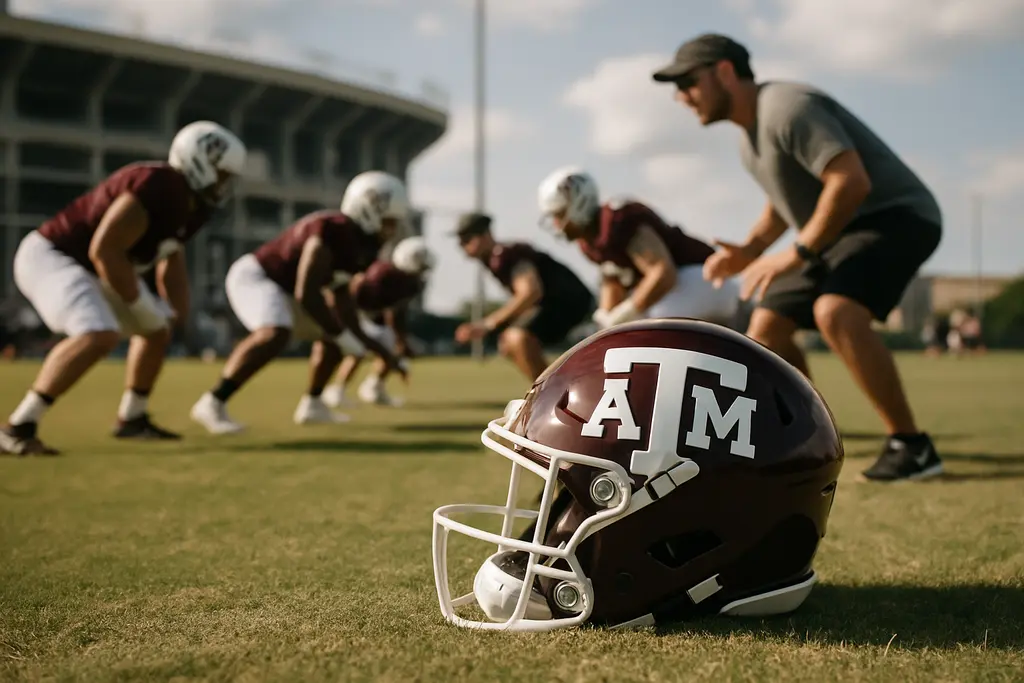

Texas A&M Depth took a clear hit on Sept. 21, 2026, when coach Mike Elko announced that Terry Bussey would miss the rest of the 2026 season with a lower-body injury suffered while returning the opening kickoff in the loss at Kentucky, according to Aggie Yell’s report. The loss does not strip the Aggies of proven receiver options, but it changes the shape of the rotation and removes one of the roster’s most useful return pieces.
Bussey’s value was tied to more than one job. In 2025, he caught 18 passes for 195 yards and one touchdown across 13 games. He also handled 18 kickoff returns for 421 yards and seven punt returns for 62 yards. That combination made him a movable offensive piece and a field-position option on special teams. Losing that profile in late September forced Texas A&M to sort out two areas at once: who takes the receiver snaps, and who handles the return work.
The Aggies had better numbers at the top of the wide receiver room than they did at several points in recent seasons, based on the early 2026 production listed in the available research. Mario Craver and Isaiah Horton had already been carrying major target volume through four games, while Ashton Bethel-Roman and Aaron Gregory represented the next wave of options. The question after Bussey’s injury was not whether Texas A&M had bodies. It was whether those bodies could cover the full range of snaps, alignments and return duties that Bussey had been positioned to handle.
Texas A&M Depth At Receiver After Bussey
Texas A&M Depth In The Top Rotation
The top of the receiver rotation remained the cleanest part of the evaluation. Craver, a junior transfer from Mississippi State, entered 2026 after a strong 2025 line of 59 catches, 917 yards and four touchdowns. Through the early portion of 2026, he was credited with 22 receptions for 225 yards and two touchdowns, with the team leaders listed by CBS Sports stats. That placed him in the lead role before the staff had to account for Bussey’s absence.
Horton also had a defined place. The graduate transfer from Alabama had 42 catches for 511 yards and eight touchdowns in 2025, then opened 2026 with 15 receptions for 213 yards and three touchdowns through four games. That profile matters because Bussey’s loss did not create only a volume issue. It pushed more late-down, red-zone and one-on-one work toward receivers already trusted to win outside or in traffic.
That is where Texas A&M Depth remains functional. Craver and Horton give the Aggies two established targets. They do not perfectly copy Bussey’s return value or all-purpose usage, but they reduce the pressure on the staff to force younger receivers into every high-leverage snap at once. The staff can still build around two receivers with early 2026 production rather than start from scratch.
Bussey’s Lost Production
Bussey’s 2025 receiving line was not massive by volume, but it was enough to matter inside a rotation. He averaged 10.8 yards per catch on his 18 receptions and carried special teams experience that cannot be replaced by simply assigning another receiver to the same spot. His injury also removed the planned split in one receiver role, where the research notes indicate Ashton Bethel-Roman and Bussey had been tied together on the depth chart.
That creates a cleaner path for Bethel-Roman, but not a risk-free one. He had 24 receptions for 503 yards and five touchdowns as a freshman in 2025, averaging 21.0 yards per catch. Through the early 2026 sample in the research, his usage was far more limited, with two catches for 13 yards through three games. The production history points to explosive ability. The early 2026 usage shows that his role had not yet matched the prior-year numbers before Bussey went down.
How The Receiver Rotation Changes
Craver And Horton Carry The Stable Floor
The first adjustment is simple: Craver and Horton become even more central to the weekly plan. Texas A&M can lean on Craver’s early target load and Horton’s touchdown production without asking the rest of the receiver room to carry the entire response. That matters in SEC play, where receiver depth is not only about catch totals. It is about keeping route speed, perimeter blocking and formation flexibility intact over four quarters.
The concern is workload. If Bussey had been expected to split snaps, return kicks and keep the rotation fresh, his absence can stack extra reps on players already carrying offensive responsibility. Texas A&M has to protect against turning a receiver depth advantage on paper into a narrow rotation on game day. The available numbers suggest the Aggies have answers, but the distribution has to hold after halftime and across consecutive SEC games.
Bethel-Roman And Gregory Get More Room
Bethel-Roman is the most direct beneficiary in the receiver rotation because his prior production gives the staff evidence that he can create chunk gains. The question is how quickly that 2025 version reappears within the 2026 offense. A player with 503 receiving yards and five touchdowns as a freshman has already shown game-level ability, but the limited early 2026 usage makes his next stretch important.
Gregory, a freshman in 2026, is the other name with a chance to grow into a more visible role. The research credits him with four catches for 41 yards and one touchdown through three games. That does not establish him as a full-time answer yet, but it shows that he had already been involved before the receiver room lost Bussey. TK Norman and Kelshaun Johnson were also noted as younger or under-used players with modest 2025 activity, which keeps them in the depth discussion if the staff needs more snaps.
This is where a related roster discussion from earlier in SEC play still fits. The Aggies entered conference strain needing more than a starting lineup, a point raised in this site’s look at Texas A&M depth faces 2026 SEC stress. Bussey’s injury put that idea into practice at one of the offense’s most visible positions.
Special Teams Replacements Matter
Return Duties Lose Certainty
The larger hidden cost is on special teams. Bussey’s 18 kickoff returns for 421 yards in 2025 gave Texas A&M a proven return option, and his punt return work added another layer. A replacement returner has to secure the ball first, create field position second and avoid handing the offense long fields after sudden changes. That is not the same job as playing a dozen receiver snaps.
Craver, Horton or Bethel-Roman could be part of the answer, based on the research notes, but each possible move carries a tradeoff. Putting a top receiver on returns can preserve explosiveness but adds collision exposure. Using a younger receiver can protect offensive starters but increases the demand on a player still earning weekly trust. Texas A&M Depth is tested most in those tradeoffs, not just in the starting receiver names.
Young Receivers Face SEC Reps
The young receivers are not being asked to replace Bussey’s entire profile in one week. They are being asked to make the rotation less fragile. Gregory’s early catch total gives the staff one data point. Bethel-Roman’s 2025 production gives another. Norman and Johnson, based on their limited 2025 work, remain less defined in the public record supplied by the research.
That distinction matters. It would be a stretch to say the Aggies have already solved the issue with one player. The supported read is narrower: Texas A&M has several candidates, but their roles vary in certainty. Craver and Horton have the strongest early 2026 statistical cases. Bethel-Roman has the strongest prior explosive production case. Gregory has the early developmental case. The return-game solution remains the least settled piece from the outside.
What Bussey’s Injury Means For Texas A&M Depth
What Is Known And What Remains Open
What is known is firm. Bussey was ruled out for the season after the Kentucky injury. He had receiver production and return-game value on his resume. Craver and Horton had already produced as the top receiving options through the early 2026 sample. Bethel-Roman and Gregory were the most logical names to absorb more opportunity, with Norman and Johnson in the broader depth picture.
What remains open is how the staff balances those pieces. If Bethel-Roman earns a larger weekly snap count, the receiver room can keep a vertical element beyond Craver and Horton. If Gregory grows into more than a spot player, the offense gains another rotation piece without overloading the top two. If the return job settles cleanly, the special teams impact becomes easier to manage.
Texas A&M Depth did not disappear with Bussey’s injury, but it became less forgiving. The Aggies still had enough receiver talent to build a workable plan. The tougher task after Sept. 21 was replacing a hybrid role that touched offense, kickoff returns and punt returns. That is a different problem than replacing one wideout on a depth chart, and it is why Bussey’s absence will remain part of every receiver and special teams evaluation for the rest of the 2026 season.