
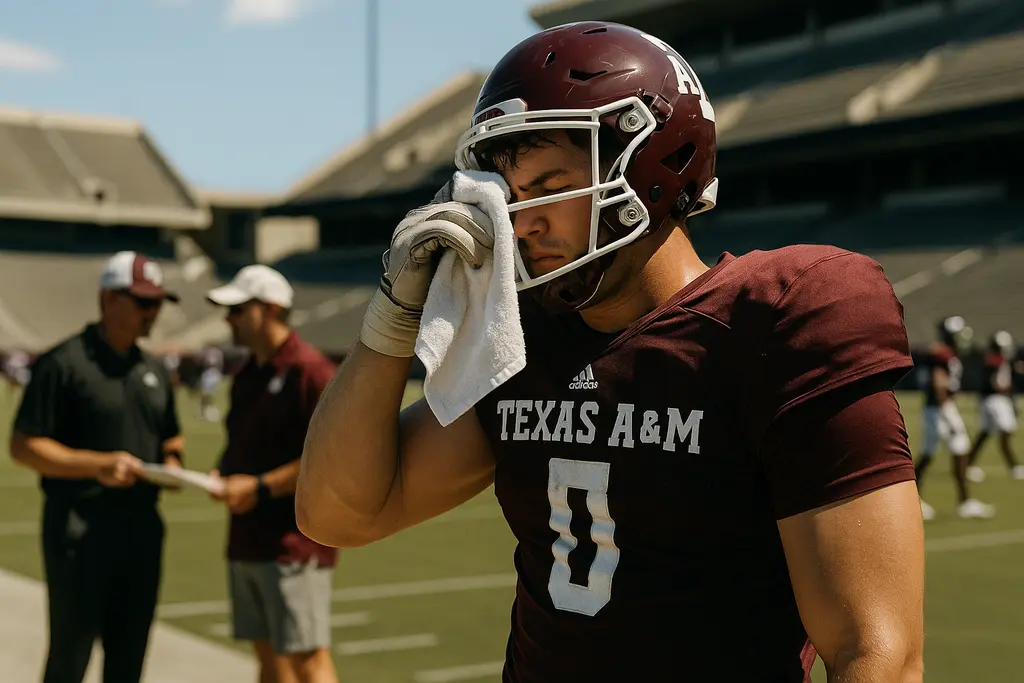

Texas A&M Fall Camp opened Aug. 1 with a practical job for Mike Elko’s staff: turn a long list of projections into a working 2026 depth chart. The first practices matter because several positions carry clear questions, from Marcel Reed’s next step at quarterback to the offensive line rebuild, linebacker depth and a reworked secondary. Sports Illustrated framed those issues among the Aggies’ central camp questions entering August fall camp questions.
For Texas A&M, early camp assessments are less about naming starters on the first week and more about identifying which players can handle repeatable assignments. The Aggies have proven names at premium spots, but they also have transfers, young players and new staff responsibilities that need practice evidence. That is why the first two weeks in College Station carry value for the 2026 outlook.
Why Texas A&M Fall Camp Sets The First Read
Practice Time Turns Projection Into Roles
Camp starts with a roster evaluation problem. The research notes identify 17 new additions, including transfers and recruits, and Yahoo Sports showed the early work around the program during spring practice spring practice look. Those additions do not become rotation players through signing-day labels. They earn work by showing assignment control, conditioning, communication and response to corrections.
The early read from Texas A&M Fall Camp gives coaches the first clear sorting period after summer training. It also helps frame how much of the depth chart is settled and how much still needs live practice data. That matters across the roster, but it is especially relevant in areas where Texas A&M is replacing known contributors or counting on transfers to close gaps.
The site’s prior review of fall camp assessments fits the same point: August is where roster theory meets daily competition. A player who flashes in isolated reps still has to show he can stack practices. A veteran who entered camp with a strong resume still has to confirm he can handle a new personnel mix around him.
Coordinator Changes Add A Teaching Layer
Elko enters his third year with new offensive and defensive coordinators, according to the research notes. That adds a teaching layer to every position battle. Players are not only competing against each other; they are also being measured on how quickly they absorb terminology, checks and situational expectations.
That dynamic can slow early evaluations if the staff is still installing base concepts. It can also clarify roles faster when players separate through communication and reliability. The Aggies do not need every answer in the first week. They do need early signs of which players can function when practice periods shift from individual work to team settings.
Texas A&M Fall Camp And The Quarterback Review
Texas A&M Fall Camp And Marcel Reed
Marcel Reed enters his junior season as the central offensive evaluation. The research notes credit him with 3,169 passing yards and 25 touchdowns in 2025. For Reed, Texas A&M Fall Camp is about proving that production can carry into a new season with better command, cleaner operation and steady decision-making during installation.
Quarterback development in August is not only measured by highlight throws. The more meaningful work often comes in protections, third-down periods, red-zone timing and how the quarterback responds after a bad series. Reed’s baseline gives Texas A&M a strong starting point, but camp should show whether the offense can operate with fewer negative plays and more control at the line.
How The Quarterback Room Shapes The Offense
Reed’s progress also affects the rest of the offensive depth chart. Receiver timing, running back protections and offensive line calls all connect to quarterback operation. If the quarterback is ahead of schedule, coaches can test more of the playbook earlier. If not, the staff may need to keep the install tighter until the supporting cast settles.
That is why this position cannot be judged in isolation. Reed’s camp work will be read through the full offensive structure, including how the line holds up and whether the receiving group can create reliable separation.
Depth Chart Pressure Points On Offense
Receiver Depth Is A Strength To Sort
The receiving corps is one of the better-positioned groups in the research notes, led by Mario Craver and strengthened by transfer Isaiah Horton. The task in camp is not just identifying the top target. It is setting the rotation, defining slot and outside roles, and finding which receivers can stay on the field in multiple personnel packages.
That competition should be one of the cleaner roster advantages for Texas A&M if the group stays on schedule. A deeper receiver room can support Reed, protect the offense from overreliance on one option and help the staff adjust to down-and-distance needs. The issue is timing. Transfers and returning players must build trust with the quarterback before game prep tightens.
Backfield And Line Need Camp Evidence
The running back rotation carries more uncertainty. Rueben Owens II is set to take the lead role after departures noted in the research. Sophomore Jamarion Morrow, listed with 182 rushing yards and one touchdown in 2025, has a chance to push for a larger role. Early camp periods should show whether the staff trusts the second and third options in protection and situational football, not only as ball carriers.
The offensive line may be the bigger swing factor. Texas A&M is replacing key players such as Trey Zuhn III and Chase Bisontis, while leaning on veterans like Mark Nabou Jr. and transfers such as Wilkin Formby. That mix puts a premium on communication. Offensive line evaluations often take longer because combinations matter as much as individual talent. Still, the staff needs quick evidence on which five-man groups can handle base calls before the opener against Missouri State.
Defensive Roles Carry Early Weight
Linebacker Depth Needs Answers
Linebacker is one of the most direct camp concerns in the research notes. Daymion Sanford’s injury creates a depth issue, and sophomore Noah Mikhail is under pressure to grow after a season listed at 16 tackles and 2.5 tackles for loss. That does not mean Mikhail has to solve the position alone. It does mean the staff needs him, and others in the room, to show readiness before the schedule starts.
Linebacker play is tied to communication, fit discipline and coverage awareness. Those traits can be hard to judge without sustained team periods. Early camp should help show whether Texas A&M has enough dependable bodies at the position or whether the staff will need to adjust packages to protect depth.
Front And Secondary Must Connect
The defensive line gives Texas A&M a stronger foundation, even after losing key starters to the draft. Senior DJ Hicks anchors the interior, while transfers T.J. Searcy and Anto Saka are expected to contribute. If that group develops quickly, it can reduce pressure on the linebackers and help the secondary through more favorable passing situations.
The back end has its own transition. Dezz Ricks is listed as the CB1 in the research notes, and transfers Tawfiq Byard and Rickey Gibson III have been added to the secondary. Cohesion is the issue. Coverage busts often come from communication errors rather than talent shortages, especially when new players are learning calls together. That makes August practice reps valuable for a defense trying to align the front, second level and secondary before the first game week.
The program’s broader list of 2026 key players tracks with that theme. Texas A&M has recognizable names, but the 2026 ceiling depends on how many of those names become stable weekly pieces.
Why Early Evaluations Matter In College Station
The season opener against Missouri State gives the staff a fixed target, but the work before that game is about more than the first opponent. Camp assessments will influence travel groups, special teams roles, substitution plans and how aggressive the coordinators can be with early-season calls. A staff that trusts its depth can play more players and keep the rotation fresh. A staff still searching for answers may have to narrow the plan.
Texas A&M Fall Camp is the first full checkpoint for a roster with both high-end pieces and unsettled rooms. Reed’s development, receiver depth, the offensive line rebuild, linebacker answers and secondary chemistry are all tied together. If the Aggies get clear practice evidence early, Elko’s staff can spend the later portion of camp refining. If the answers stay cloudy, the first month of the season may carry more experimentation than the staff would prefer.