
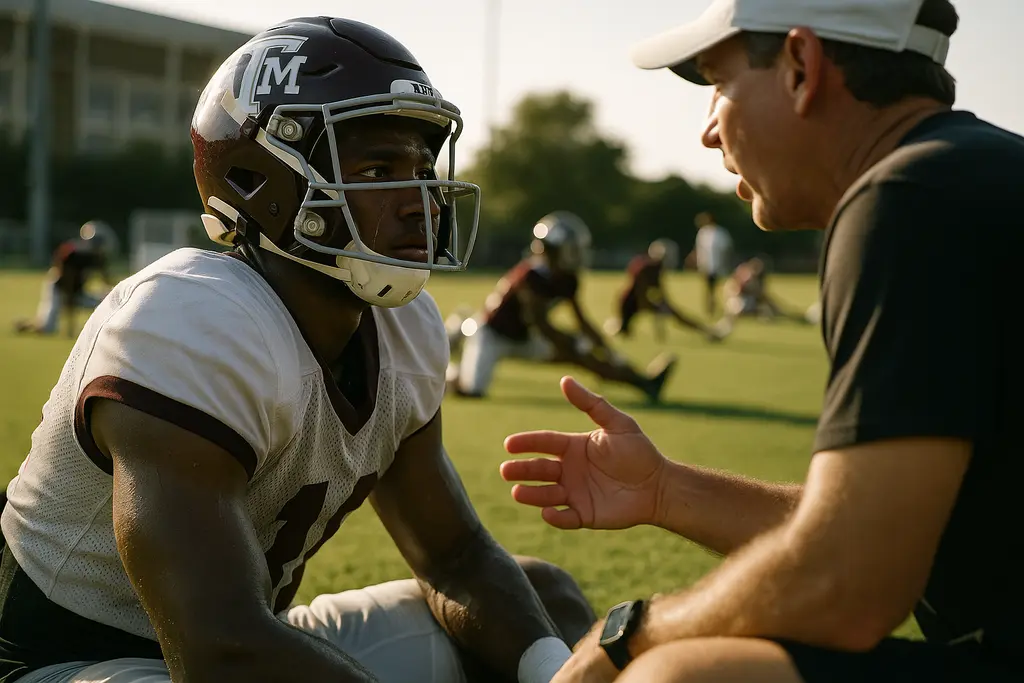

Texas A&M Fall Camp opened Aug. 1, 2026, in College Station, starting the first on-field sorting period for a roster with real competition at several spots, according to Houston’s camp date report. The early attention sits where the production gap is clearest: running back, linebacker and wide receiver depth. Those are not cosmetic battles. They touch how Texas A&M can protect its offense, hold up through SEC contact and avoid becoming too dependent on a small group of skill players.
The reporting available at this stage points most clearly to three position groups, with Sports Illustrated identifying running back rotation, linebacker and the third receiver role as key camp competitions in its Texas A&M position battles report. That does not settle the depth chart. It gives a framework for what matters before the staff gets deeper into practice evaluation, scrimmage work and game-week roles.
Texas A&M Fall Camp Starts With Backfield Questions
Texas A&M Fall Camp Running Back Rotation
The running back room has the most direct production question. Le’Von Moss and EJ Smith are gone to the NFL after combining for 609 rushing yards and 10 touchdowns in 2025, per the same Sports Illustrated report. That leaves a workload to redistribute, but it does not leave the Aggies without a returning producer.
Rueben Owens II is the clear starting point. He led Texas A&M with 639 rushing yards and five touchdowns last season. That matters because camp is not just about finding a talented runner; it is about identifying the back who can handle the weekly volume, fit the protection plan and stay efficient when defenses load the box. Owens has the best statistical case among the backs listed in the current competition.
Jamarion Morrow is expected to have a larger presence, while redshirt freshman Tiger Riden and true freshmen KJ Edwards and Carsyn Baker are competing for time. The key word is rotation. In SEC play, one back rarely carries the full physical burden from September through November. Texas A&M needs a dependable pecking order behind Owens, especially if the offense wants to keep pace without asking the passing game to solve every long-yardage situation.
What The Backfield Battle Means For The Offense
The early read from Texas A&M Fall Camp should be less about one flashy run and more about down-to-down trust. Pass protection, ball security, short-yardage feel and receiving ability can decide snaps as much as open-field speed. If Owens holds the lead role and one of the younger backs proves ready for a real series-by-series job, the Aggies can manage the position with more flexibility. If the gap behind him remains wide, the staff could be forced into a heavier workload for its most proven back.
That is why this position carries more weight than a normal camp rotation story. The Aggies are replacing touchdown production and searching for week-to-week reliability at the same time. The staff does not need to name every role immediately, but it does need to leave camp with a clear plan for early-down carries, change-of-pace work and late-game snaps.
Linebacker And Receiver Jobs Carry SEC Weight
Linebacker Response After Daymion Sanford Injury
Linebacker is the defensive battle with the sharpest edge because of Daymion Sanford’s serious injury during the Maroon and White game. Sanford had 57 tackles, 9.5 tackles for loss and 3.5 sacks in 2025. That is not a minor absence. It removes a player who showed production behind the line of scrimmage and could affect the communication structure of the front seven.
Sophomore Noah Mikhail and junior Jordan Lockhart are listed as contenders to fill the void. Mikhail had 16 tackles and 2.5 tackles for loss last season, giving him some recorded production but not the same proven volume as Sanford. Lockhart’s camp opportunity is tied to the same issue: Texas A&M needs more than a body in the lineup. It needs a linebacker who can fit the run, handle space and limit missed assignments against offenses that will test eye discipline.
This is where practice separation becomes important. The staff can evaluate pursuit speed in drills, but the more telling work comes when backs press cutback lanes and quarterbacks force linebackers to declare in coverage. Texas A&M Fall Camp will test whether the next option at linebacker can play clean football before the schedule applies pressure.
Third Receiver Role Behind The Primary Targets
The receiver room has a different type of competition. Mario Craver and Alabama transfer Isaiah Horton are described as primary targets, while the third receiver spot remains open. Ashton Bethel-Roman is a leading candidate, with Terry Bussey, true freshman Aaron Gregory and redshirt freshman Jerome Myles also pushing for roles.
The third receiver job matters because it shapes how defenses can treat the Aggies’ top options. If the third spot is stable, Texas A&M can spread the field and create cleaner matchups. If that role remains unsettled, opponents can tilt coverage toward the primary targets and force the offense to win through less proven pieces.
Bethel-Roman’s status as a leading candidate gives him the first name to watch, but Bussey, Gregory and Myles keep the competition open. The staff will be sorting more than catches. Blocking effort, route precision, spacing and assignment reliability all affect whether a receiver is trusted in tempo situations and third-down packages.
Depth Chart Stress Points Beyond The First Unit

Why The Second Group Matters
The public camp discussion often centers on starters, but the more useful question is whether Texas A&M can build a second layer at the spots under stress. Running back, linebacker and wide receiver all require depth for different reasons. Running backs absorb weekly contact. Linebackers handle special teams and defensive rotation work. Receivers need enough bodies to sustain tempo and personnel variation.
That makes the younger names worth tracking even if they do not win first-team jobs right away. Riden, Edwards and Baker can still affect the backfield if one becomes trusted in a specific role. Gregory and Myles can change the receiver picture if either proves ready ahead of schedule. Mikhail and Lockhart can give the defense a cleaner answer if one separates early and allows the staff to define the remaining linebacker rotation around him.
What Coaches Can Learn In Camp
Texas A&M Fall Camp is the first extended setting for coaches to compare players through repeated practice situations. One scrimmage period does not decide the season, but a pattern of clean assignments usually matters. For running backs, that can mean identifying blitzes and finishing short-yardage runs. For linebackers, it can mean fitting the correct gap and communicating before the snap. For receivers, it can mean being in the right spot when the quarterback expects it.
That is the value of these competitions before a public depth chart becomes meaningful. The staff is not only ranking talent. It is deciding which players can be trusted when the game plan tightens and the margin for assignment errors shrinks.
Why These Battles Matter Before September
Early Answers Could Shape The 2026 Plan
For Texas A&M Fall Camp, the significance is practical. The Aggies have returning production in Owens, a linebacker void created by Sanford’s injury and an open receiver role behind Craver and Horton. Each battle affects the way Texas A&M can call games. A deeper backfield can protect the offense from becoming one-dimensional. A settled linebacker answer can keep the defense from shifting too much responsibility elsewhere. A reliable third receiver can punish defenses that overplay the top targets.
There is still uncertainty because camp has only started and the available reporting does not provide a final depth chart. That is the proper read for early August. The names are known, the openings are clear and the next step is separation through practice. If Texas A&M finds dependable answers at those three spots, the roster enters the season with fewer pressure points. If the battles stretch deep into game preparation, the staff may have to manage those positions more carefully once the schedule begins.