
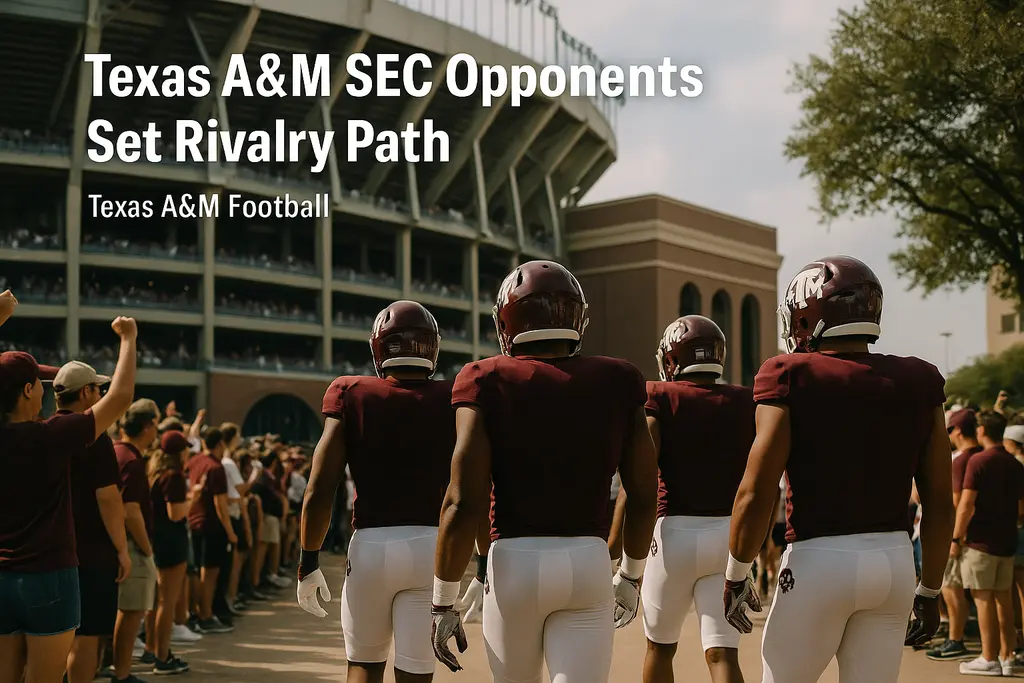

Texas A&M SEC opponents are now set for the 2026 through 2029 football seasons, and the league’s new format gives the Aggies three annual conference matchups: Texas, LSU and Missouri. The SEC announced the opponent assignments as part of its shift to a nine-game conference schedule beginning in 2026, with each program set to play every other league member at least once every two years and host every opponent during the four-year span Texas A&M announcement.
For Texas A&M, the structure does more than fill future dates. It locks in two games with clear regional and recruiting weight, keeps a newer annual series in Missouri on the calendar, and changes how the Aggies will manage roster depth across a longer SEC slate. The annual opponents also give fans a clearer planning window for travel, home-game demand and the kind of conference rhythm that has been missing in the expanded league model.
How Texas A&M SEC Opponents Were Set
The format applies to the 2026, 2027, 2028 and 2029 seasons. Texas A&M will play LSU, Missouri and Texas each year during that window. The rest of the conference schedule rotates, with the SEC’s stated plan designed to create more regular cross-league exposure than the previous divisional setup allowed.
Texas A&M SEC Opponents By Annual Slot
The three annual opponents carry different meanings for the program. Texas brings the in-state rivalry back into a fixed annual position. LSU keeps a border-state series in place that already carries late-season weight in the SEC West era. Missouri gives the Aggies a consistent matchup with a former Big 12 opponent that has shared more conference history with A&M than some newer SEC pairings.
- Texas: Annual opponent from 2026-2029 after the rivalry returned in 2024.
- LSU: Annual opponent from 2026-2029, maintaining a regular regional SEC matchup.
- Missouri: Annual opponent from 2026-2029, preserving a recurring series from shared Big 12 and SEC membership.
The SEC’s nine-game format also requires each school to schedule at least one high-quality non-conference opponent from the ACC, Big Ten, Big 12 or Notre Dame each season, according to the Texas A&M release. That requirement matters because the annual conference structure will not stand alone when judging strength of schedule. The non-conference piece will still shape September stress, roster usage and postseason arguments.
Rivalry Impact For Texas, LSU And Missouri
The headline for many Aggies is Texas. The Texas-Texas A&M rivalry resumed in 2024 after a 12-year hiatus, and the new format keeps it annual through 2029 Houston Chronicle report. That creates scheduling clarity for a game that matters far beyond the standings. It affects recruiting conversations, donor interest, student demand and the week-to-week tone around both programs.
Texas As The Fixed In-State Game
The annual Texas game gives the Aggies a permanent in-state measuring point during a period when both programs are competing under the same SEC structure. The rivalry had been absent from the regular calendar for more than a decade before its return. Now, the conference format removes uncertainty through 2029 and gives the game a defined place in the league’s rotation.
That does not mean the matchup will look the same every year. Venue, timing and roster cycles will change. What stays constant is the yearly comparison. For Texas A&M coaches, the game becomes part of roster planning, not a special one-off. For players from Texas high school programs, it becomes a recurring stage. For fans, it gives the season a familiar reference point in a league schedule that will otherwise rotate more often.
LSU Remains A Regional SEC Test
LSU staying annual makes sense from a regional and competitive standpoint. Texas A&M and LSU have played regularly since the Aggies entered the SEC, and the game has developed enough edge to remain a fixture in the expanded league. It keeps the Aggies connected to one of the conference’s key Gulf-region programs and maintains a game that often carries recruiting visibility in East Texas, Louisiana and the broader SEC footprint.
The Texas A&M SEC opponents assignment also means the Aggies will not lose every piece of their SEC West identity in the post-division era. The league has moved away from divisions, but keeping LSU annually gives A&M a familiar physical matchup and a known travel pattern. That continuity matters in a schedule model built to rotate more teams through Kyle Field and send the Aggies to more SEC venues over a four-year period.
Missouri Adds A Different Kind Of Annual Series
Missouri is the least emotional of the three annual opponents for many fans, but it is not random. The Aggies and Tigers shared time in the Big 12 before both became SEC members. That creates a conference thread that predates the SEC expansion moves of the past few years. The series does not carry the same public intensity as Texas or LSU, but annual games can build sharper stakes over time.
From a football standpoint, Missouri also gives Texas A&M a different style of league opponent than the two border-state rivalry games. The travel profile, recruiting overlap and game-week tone are different. That variety is part of what the SEC is trying to create with a format that protects some annual games while rotating the rest of the league more often.
Schedule Pressure Under The Nine-Game SEC Model

The move to nine conference games changes the margin for error. Texas A&M will have one more SEC game each season than it played under the eight-game model. That means fewer soft spots, more injury-management pressure and more demand on second-team players across the offensive line, defensive front and special teams units.
The format also changes how fans should read future schedules. A four-year window that guarantees every SEC opponent appears at least once every two years gives the Aggies more exposure to programs they previously saw less often. It also means players who stay in the program for multiple seasons should see a wider range of SEC venues and opponents than many prior A&M classes did.
The Texas A&M SEC opponents format will not settle every competitive-balance debate. Some annual opponent sets will be viewed as tougher than others, and the rotating pieces will still affect season difficulty. But the conference has put a clearer system in place: three annual opponents, six rotating league games, and a non-conference requirement that keeps power-conference scheduling on the table.
Why Texas A&M SEC Opponents Matter Through 2029
The practical impact is clarity. Texas A&M knows its three annual league opponents through 2029, and that helps the program plan recruiting weekends, fan travel, season-ticket demand and long-range roster needs. For supporters, it means Texas and LSU remain core dates while Missouri becomes a regular reference point in the conference race.
There is still uncertainty beyond the four-year cycle. The announced structure covers 2026-2029, not the full future of SEC scheduling. Annual opponents could be reviewed after that period, and the league’s next move will depend on how the format works competitively and logistically. For now, the Aggies have a defined path: keep the Texas rivalry annual, maintain LSU as a regional SEC fixture, and build a steadier annual series with Missouri while the rest of the league rotates through more often.
For a program and fan base that measure seasons through rivalry stakes as much as records, that is the key change. The schedule now gives Texas A&M a fixed rivalry spine and a broader SEC rotation around it. That combination will shape how the Aggies build depth, how fans plan fall weekends and how the league frames A&M’s place in the expanded conference through 2029.