
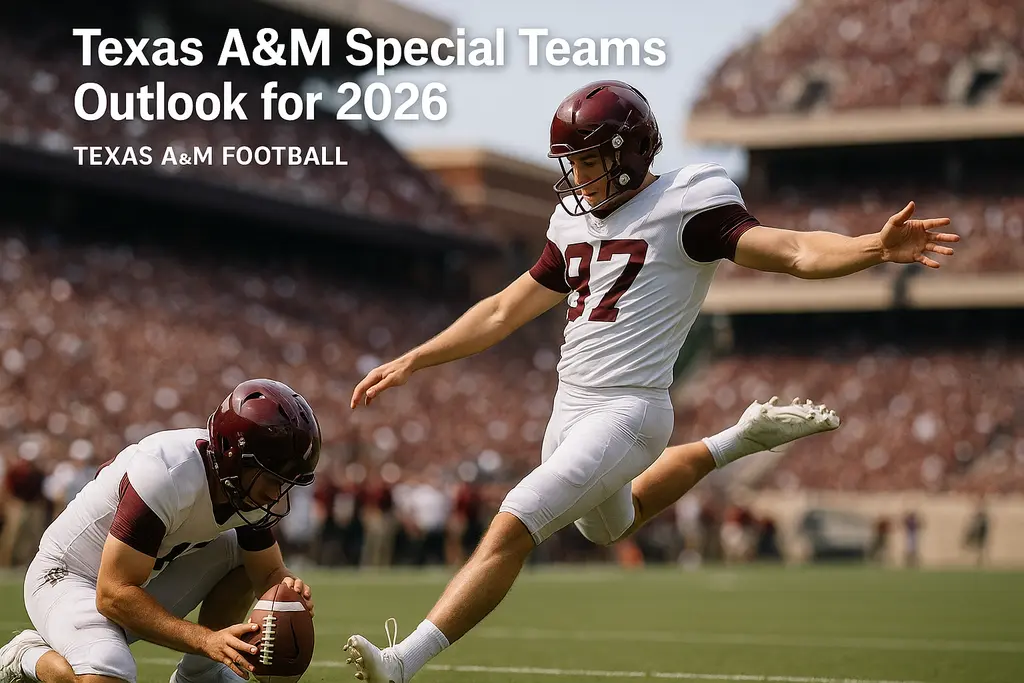

The Texas A&M special teams outlook enters late July with more evaluation than certainty. As of July 29, 2026, the Aggies have not officially announced a starting kicker, punter or primary return group. That keeps one of the program’s more practical preseason questions open as Mike Elko’s team moves toward its Sept. 5 opener against Missouri State.
The kicking game was not clean enough in 2025 to be treated as a settled area. Texas A&M kickers made 16 of 26 field-goal attempts, a 61.5 percent rate, while converting 55 of 56 extra points for a 98.2 percent rate. The extra-point operation was stable. The field-goal production left room for a firmer answer before SEC play brings tighter fourth-quarter situations.
Special teams rarely carry the front-page attention that quarterback competitions and defensive rotations draw in College Station. They still shape field position, possession value and late-game management. For this A&M team, the preseason work is less about naming stars and more about identifying trustworthy specialists, clean operations and coverage units that do not give away yards.
Texas A&M Special Teams Outlook Starts With Open Jobs
Kicker Competition Remains Unsettled
The starting kicker has not been officially announced. That is the central fact around the position right now. A&M’s 2025 field-goal rate gives the staff a clear reference point: the job is not just about leg strength, but repeatable operation under pressure. The holder, snapper and protection unit all factor into that answer, though no official depth chart has been released.
The Aggies do not need to settle the position publicly in July. They do need clarity inside the building before the opener. A kicker who can handle standard attempts, protect extra-point consistency and avoid special-teams swings would help Elko manage early-season games without overextending the offense on fourth down.
Punter Evaluation Carries Field-Position Weight
The punter job also remains undetermined based on the available information. That keeps the field-position piece of A&M’s special teams in evaluation mode. Punting is not only gross distance. Hang time, directional control, operation time and coverage fit determine whether a punt flips the field or creates return stress.
For an SEC roster trying to build week-to-week consistency, the punter can protect the defense from short fields. That matters in early games when offensive rhythm is still being tested and when the staff is deciding how aggressive it wants to be near midfield.
Return Game And Coverage Work Set The Margin
Returners Need Trust Before Flash
Texas A&M is still assessing candidates for kickoff and punt return duties. The stated focus is speed and reliable hands. That order matters. A returner who can make the first defender miss has value, but the first requirement is ball security. Punt return decisions, in particular, can swing a possession before the offense ever takes the field.
The return game is also tied to roster depth. Defensive backs, wide receivers and running backs often provide the athletic profile for those roles, but the staff has to weigh return value against workload and injury exposure. No official return depth chart has been released, so any firm assignment would be premature.
Coverage And Blocking Were Spring Priorities
Spring practice placed emphasis on special teams techniques, including coverage schemes and blocking assignments. That points to a staff trying to reduce inconsistency from the previous season rather than simply waiting for one specialist to fix the unit. Coverage lane discipline, kickoff placement, punt protection and return blocking all require coordinated reps across players who may also hold offensive or defensive roles.
A&M has also made special-teams ability part of its recruiting focus. That is a practical roster-building point. Young players who are not yet in the offensive or defensive two-deep can still travel, cover kicks and build trust through special teams. For a program trying to close the gap between talent and weekly execution, those developmental snaps carry value.
Schedule Timing Adds Early Pressure
Missouri State Opens The Test
Texas A&M opens the 2026 season against Missouri State on Sept. 5 at 6 p.m. CT on ESPN, KBTX reported. That first game gives the staff a controlled setting to test its operation in front of a full game-day environment. It also starts the clock on decisions that may still be fluid during preseason camp.
Opening nights often reveal small details that practices do not. Snap tempo, substitution management, return communication and coverage fits can look different when the game is live. If A&M is rotating multiple specialists or return candidates early, the staff will need to balance evaluation with clean execution.
Arizona State Brings Different Demands
The Aggies’ second game against Arizona State is scheduled for Sept. 12 at 11 a.m. CT on ABC, according to the same kickoff announcement. That short runway raises the importance of clean special-teams tape from Week 1. A&M will not have much time to sort through basic operation issues before facing a higher-profile nonconference opponent.
The early kickoff also changes game-day rhythm. Warmups, specialist timing and return communication all move up. Those are not excuses; they are part of preparation. A settled specialist group gives the staff fewer variables in that kind of window.
Why The Kicking Game Matters For Elko’s 2026 Team
Consistency Is The Program Standard
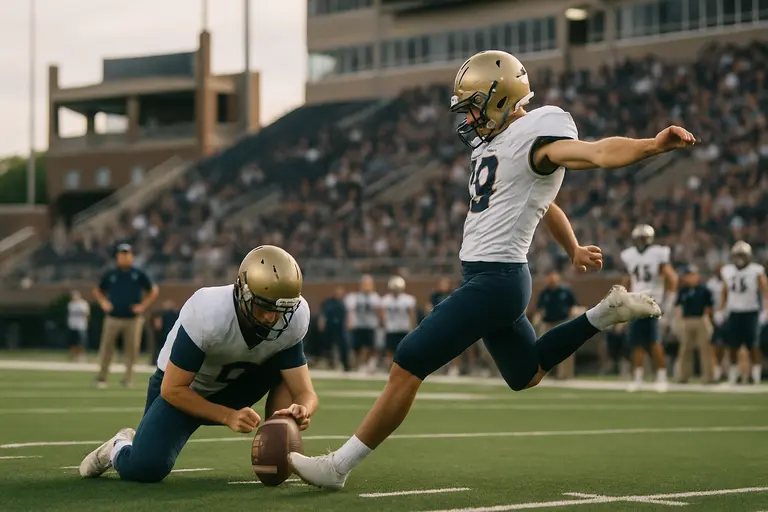
Elko’s broader message entering 2026 has centered on sustained performance. He said, “We have found ways, at times over the years, to hit one-year peaks. The next step for us is consistently being a top-10 team, consistently being a playoff team, consistently being a team that finishes and gets to Atlanta,” Athlon reported. Special teams fit directly into that standard because they test weekly discipline, not just high-end talent.
A team chasing that type of consistency cannot afford to treat the kicking game as a side project. Missed field goals, poor punt coverage and return-game mistakes do not always show up as long-term trends, but they can decide one-possession games. In the SEC, that is often the difference between controlling a season and chasing repairs by October.
Staff Change Adds Accountability
Texas A&M has appointed a new special teams coordinator for the 2026 season, based on the available information. The coordinator’s name was not included in the research notes, so the responsible view is to focus on the assignment rather than attach unsupported detail. The job is clear: improve reliability across the kicking, punting, coverage and return phases.
Coordinator changes can bring new drill structure, new personnel groupings and new weekly standards. The key is whether those changes show up in cleaner decisions and fewer hidden-yardage losses. With open jobs at kicker and punter, the coordinator also has to help the staff separate practice consistency from game-ready trust.
What Must Be Settled Before Week 1
The Practical Checklist
The Texas A&M special teams outlook is not defined by one missing name on a depth chart. It is defined by several connected decisions that have to be made before the Aggies run out at Kyle Field. The staff needs a dependable placekicker, a punter who fits the coverage plan, returners who protect the ball and coverage units that understand leverage and spacing.
- Kicker: identify the best option for field goals while maintaining extra-point reliability.
- Punter: settle on the player who gives the defense usable field position.
- Returners: prioritize secure catches, smart decisions and enough speed to threaten open space.
- Coverage units: carry spring technique work into live game operation.
- Coordinator structure: turn a staff change into clearer roles and weekly accountability.
Those are not headline-grabbing items, but they are the details that separate a clean Saturday from a frustrating one. A&M has time in camp to sort the jobs. The first public answer arrives Sept. 5, when the Aggies’ kicking game moves from projection to game tape.