
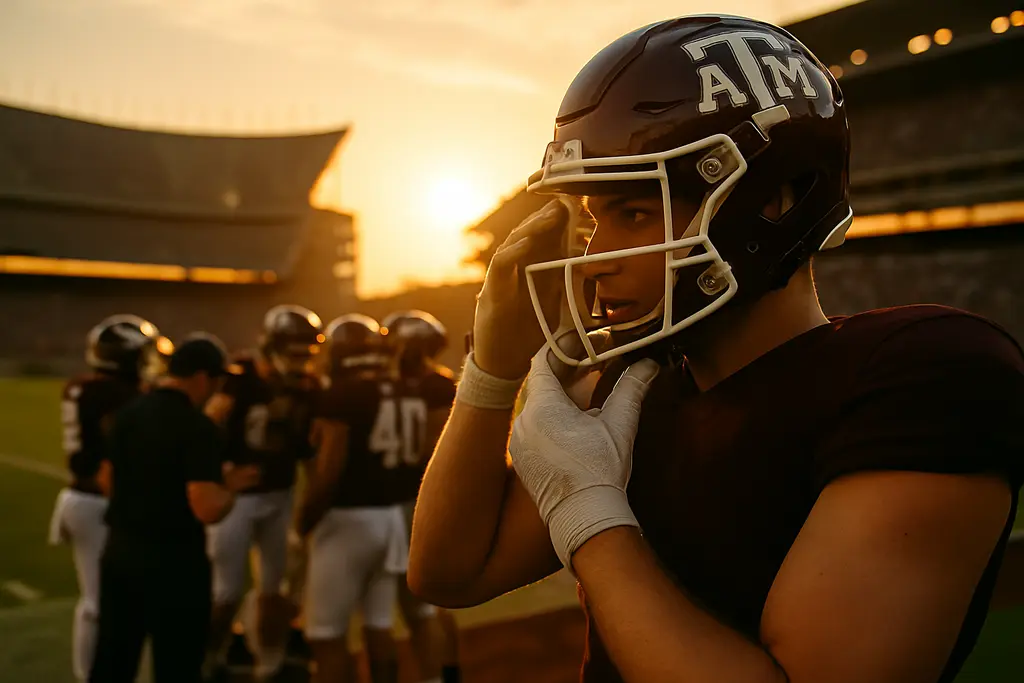

Texas A&M Defense entered SEC play with clear offseason talking points: replace proven front-seven production, tighten run fits and get the back end aligned fast enough to handle league tempo. One game into the SEC schedule, after a 31-21 loss to Kentucky on September 20, 2026, those points are no longer theoretical. The Aggies managed two sacks and three tackles for loss in that game, and the issues handling power runs and inside concepts put the next round of defensive adjustments on the staff’s desk immediately.
Mike Elko’s public comments through July and August pointed toward this exact pressure point. The Aggies knew the defensive front would need new answers after losing major 2025 contributors. They also knew modern SEC offenses were changing how they communicate, check plays and force defenses to declare. The Kentucky result gave Texas A&M a firmer read on where the work has to start.
Texas A&M Defense Reset After Kentucky
Texas A&M Defense Needs Cleaner Fits
For Texas A&M Defense, the first correction is not cosmetic. The run game exposed the cost of small mistakes at the point of attack. When power plays and inside runs hit with timing, linebackers have to fit downhill with the right leverage, interior linemen have to hold their gaps, and safeties have to arrive as support rather than as first contact. The Kentucky loss showed that one missed fit can quickly turn into a drive-sustaining gain.
That does not mean the Aggies lack pieces. It means the pieces are still being sorted under SEC stress. Elko said at his July 22, 2026 SEC Kickoff appearance that since he arrived in 2018, Texas A&M has “had more defensive linemen drafted than any program in the country,” while also noting the challenge of replacing that type of defensive front talent, according to the official SEC Kickoff recap. That history helps explain the standard, but it does not solve the 2026 rotation by itself.
What The Kentucky Game Showed
The key from September 20, 2026 was not just the final score. It was the way Kentucky stressed the Aggies with physical run concepts and forced the defense to win early downs. Two sacks can matter in a close game, but the larger issue was the lack of disruption on normal downs. Three tackles for loss left too many manageable situations, and that put pressure on every coverage call behind it.
Texas A&M had shown a different version of the defense before SEC play. In the win over Arizona State, the Aggies forced three straight fourth-quarter turnovers, including two interception returns for touchdowns. That finish showed the defense can change a game when coverage, rush and ball skills hit together. The next step is making that same group sturdier before those takeaway chances appear.
Front Seven Communication And Line Rotation
Replacing Draft-Level Production
The personnel reset is central to the adjustment plan. The Aggies had to replace SEC Defensive Player of the Year Cashius Howell, defensive tackles Albert Regis and Tyler Onyedim, captain and multi-year starting linebacker Taurean York, and top cover corner Will Lee III from the 2025 defense. That is not a single-position hole. It cuts through leadership, interior strength, edge production, linebacker command and coverage stability.
The transfer additions and returning pieces give Elko options, but the rotation has to settle into defined jobs. Northwestern edge transfer Anto Saka arrived after earning All-Big Ten honorable mention in 2025. Interior defensive linemen CJ Mims from North Carolina and Angelo McCullom from Illinois were added to the room. Returners T.J. Searcy, Marco Jones and Sam M’Pemba remain part of the defensive front picture.
- Edge pressure: The Aggies need enough rush to avoid sending extra bodies too often.
- Interior control: The defensive tackles have to reduce vertical push on inside runs.
- Linebacker timing: New communication rules make clean calls before the snap more valuable.
- Rotation balance: Depth matters only if the staff can trust the second wave in tight SEC possessions.
Linebacker Calls In A Slower Game
Elko also tied the defensive adjustment to how college offenses are operating before the snap. At SEC Media Days on July 22, 2026, he said the game has “slowed down,” with offensive coordinators communicating directly at the line of scrimmage, and pointed to linebacker communication as an area defenses must improve, according to a SEC Media Days report. That matters because the defense is no longer just matching tempo. It is matching information.
Texas A&M Defense is not built around one call fixing every look. The staff has to teach the front, linebackers and safeties to handle late offensive movement without creating hesitation. In August, Elko said the staff had reviewed how it was teaching concepts so players could play faster, freer and more consistently, with a focus on tightening the run defense and improving fundamentals. The Kentucky game made that teaching point feel immediate.
Secondary Depth Must Match SEC Stress
Corners And Safeties Carry More Responsibility
The secondary is part of the run-defense answer, not a separate file. Returning corners Dezz Ricks and Julio Humphrey, Tennessee transfer Rickey Gibson III and rookie Brandon Arrington give the Aggies several coverage options. At safety, Dalton Brooks and Marcus Ratcliffe entered 2026 after combining for 127 tackles, 8.5 tackles for loss, three sacks and one interception in 2025. That production gives the back end a base, but SEC offenses will keep testing eye discipline.
Dezz Ricks said on September 15, 2026 that there was “a lot to fix,” while expressing confidence that the defense could improve over the next couple of weeks as SEC play began. T.J. Searcy also pointed to defensive depth, saying players can operate at maximum effort because capable replacements are behind them. That depth claim now has to show up in late-game tackling, not just in snap counts.
Turnovers Remain The Counterweight
The Arizona State finish showed Texas A&M Defense can flip field position quickly when the back end is decisive. Two interception returns for touchdowns are not a weekly plan, but they do show a path for a defense still working through front-seven changes. If the pass rush speeds up throws and the safeties stay connected to the coverage structure, the Aggies can create the kind of sudden-change plays that offset uneven stretches.
The caution is that takeaways cannot cover up run-fit issues forever. SEC opponents will keep handing the ball off if they see light boxes, slow linebacker fits or safeties forced into bad angles. That is why the run game and coverage calls are tied together. A cleaner early-down defense gives the secondary better pass situations. Better pass situations give the rush more freedom. That is the cycle Texas A&M is trying to build.
The same theme has been central to the program’s broader 2026 plan, including this site’s prior review of the 2026 defensive plan. Depth is valuable, but it has to translate into assignment certainty when the schedule turns physical.
Why The SEC Run Fits Matter Now
Texas A&M Defense does not need a full identity change after one SEC game. It needs sharper first-level control, cleaner linebacker communication and steadier safety support against inside runs. The roster has portal additions, returning defensive line options and experienced defensive backs, but the Kentucky loss showed the gap between having pieces and playing connected SEC defense.
The next adjustment phase is about proof. Can the interior line force more second-and-long situations? Can the linebackers handle late offensive checks without slowing down? Can the secondary support the run without giving up easy throws behind it? Those questions now frame the Aggies’ remaining SEC work after September 20, 2026. The answers will determine whether the defense becomes a steady part of the team’s week-to-week plan or keeps forcing the offense to chase games from behind.