
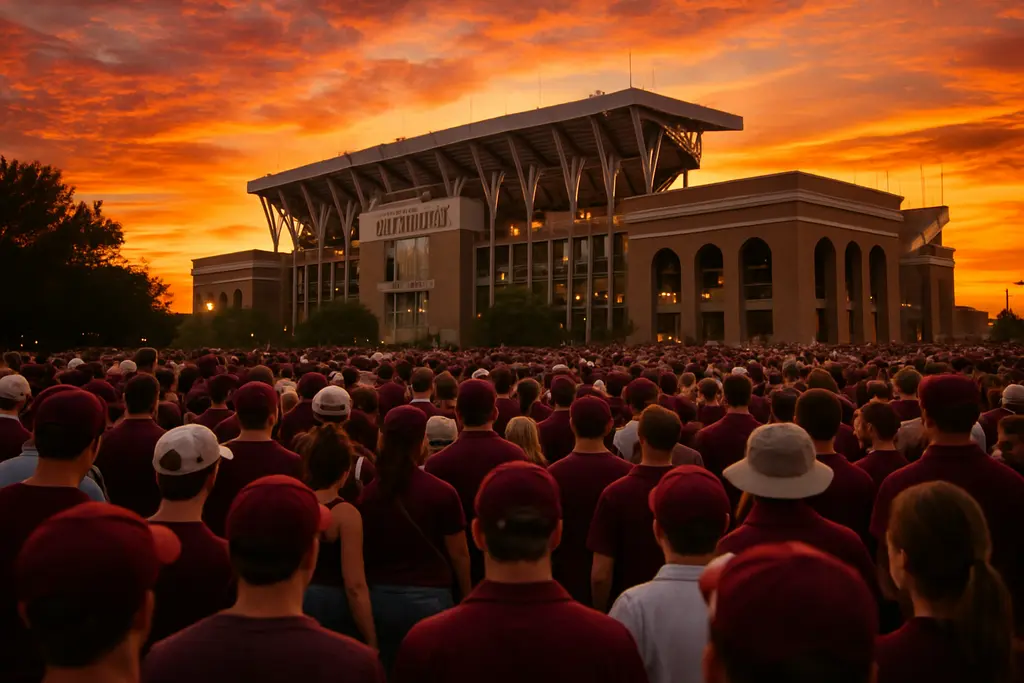

Kyle Field Traffic is never just a line of cars on Wellborn Road. For Texas A&M fans, it is the first test of a football Saturday: the family caravan from Houston or Dallas, the former student trying to reach a tailgate before yell practice stories start, the student crossing campus with a water bottle and a maroon towel. The 2026 adjustments near Kyle Field mattered because they touched those small rituals long before the Aggies ran out of the tunnel.
The phrasing around these changes can sound ordinary: lane restrictions, exit modifications, closure windows, shuttle routes. Inside College Station, those words shape whether the 12th Man arrives calm or irritated, early or late, scattered or together. As of October 15, 2026, the September 5 season opener against Missouri State had already passed, so the right way to judge the changes is not to call that game upcoming. The opener gave Texas A&M a public test case for a broader game-day traffic plan that still matters whenever fans return to campus.
Why Kyle Field Traffic Adjustments Carry Weight
Kyle Field Traffic Is A Human Issue
The significance of Kyle Field Traffic starts with scale and habit. Fans learn their own routes over years: which ramp feels fastest, which garage empties best, which street becomes a wall of brake lights after the fourth quarter. Any change near Kyle Field asks people to unlearn part of their Saturday. That is why even a narrow adjustment can feel larger than it looks on a map.
Texas A&M Transportation Services said on September 3, 2026, that there would be no lane closures or restrictions on Highway 6 for the September 5 opener against Missouri State despite ongoing construction, while still urging drivers to slow down and stay alert because road conditions had changed Texas A&M Transportation Services said. That detail carried two messages at once. The first was reassurance: the main highway artery would not be squeezed by formal lane closures on that game day. The second was caution: familiar pavement did not mean familiar driving conditions.
The Opener Showed The Split Between Relief And Caution
That split is the heart of the 2026 traffic story. No Highway 6 lane closure sounds like good news, and for many fans it was. But traffic planning around Kyle Field is rarely solved by one open road. The northbound Texas Avenue exit, a common game-day route, had been modified for the Missouri State opener, and alternate routes were recommended for drivers who knew the area well. That point mattered because experienced Aggies often lean on memory. A parent who has parked the same way for a decade may not check a map until a cone line or altered exit forces the issue.
For more route-level context on how the broader plan affected arrival habits, the site’s earlier breakdown of 2026 transportation changes fits with the same central point: the plan was not only about cars. It was about spacing out pressure before it hit the stadium edge.
What Changed Around Highway 6 And Texas Avenue
No Lane Closures Did Not Mean No Attention
The Highway 6 note deserves a careful reading. It did not say the corridor felt unchanged. It said there were no game-day lane closures or restrictions for the September 5 opener. That distinction matters in a college town where football traffic arrives in waves. A construction zone without a lane closure can still alter sight lines, shoulder space, merge confidence and driver patience. For visiting fans, the adjustment can be even sharper because they may be reading signs, watching GPS prompts and trying to keep up with the flow all at once.
The most practical lesson is that game-day traffic management is not only about capacity. It is also about predictability. If fans know Highway 6 remains open but also know conditions have shifted, they can leave earlier without treating the entire trip like a crisis. That balance is what transportation officials try to create: enough warning to change behavior, not so much alarm that everyone floods the same alternate street at the same time.
The Texas Avenue Exit Shift Hit Familiar Habits
The modified northbound Texas Avenue exit stood out because it touched a route many fans already trusted. Texas Avenue is part of the mental map of Aggie football. It is tied to restaurants, hotels, campus edges and the final approach toward Kyle Field. When that path changes, even slightly, the ripple reaches more than one intersection.
For local drivers, alternate routes are useful only when they are chosen before the rush begins. For visitors, they work best when instructions are simple and repeated. The 2026 message made clear that fans familiar with the area should consider different approaches. That is a subtle but meaningful admission: the people most likely to rely on muscle memory may be the ones most likely to get surprised.
How Campus Movement Changed Near The Stadium

West Campus Garage Became More Than Parking
The new pedestrian passageway through the basement level of West Campus Garage may be the most fan-centered change in the 2026 guidance. Beginning with the 2026 season, that passage connected the northeast corner and the Reed Arena side, easing pressure between walk-in traffic, tailgates and the stadium. In plain terms, a garage became part of the pedestrian system.
That matters around Kyle Field because the walking crowd has its own rhythm. Cars can be held by lights and officers; pedestrians spill out in friend groups, family clusters and student streams. When those groups collide near tailgate areas and stadium gates, the experience tightens. A passageway that gives people another defined route can lower that friction. It does not need to be flashy to matter. It just needs to keep people moving without making them feel pushed.
Timing Became The Real Control Point
The standing time windows are just as important as the physical changes. Texas A&M guidance says road closures around campus begin 4½ hours before kickoff, with streets including Houston Street, Joe Rout Boulevard, Gene Stallings Boulevard and part of Olsen Boulevard between Reed Arena and West Campus Garage affected game-day transportation guidance. Post-game closures usually begin at the start of the fourth quarter, setting up the outbound push before the final whistle.
That fourth-quarter timing can shape choices inside the stadium and outside it. Some fans stay until the last note of the War Hymn. Others leave early for children, long drives or parking-lot logistics. Transportation planning has to account for both groups without judging either one. The guidance for drivers west of FM 2818 to use Wellborn Road and then Deacon Drive or Rock Prairie Road, while north-side drivers use Villa Maria Road, shows how the exit plan tries to divide pressure by destination.
- Shuttles begin three hours before kickoff and run until one hour after the game ends.
- Free on-campus shuttle routes are available.
- Off-campus options include routes 22, 26, 31 and 36, plus the Downtown Bryan Game Day Shuttle from Roy Kelly Garage.
- Parking for fans without permits opens at 7:00 a.m. near Bush Library, the Bonfire Memorial and Agronomy Road, with prices listed from $25 to $40.
Those details turn a traffic plan into a set of choices. A family can decide whether to park early and ride, walk from a remote lot, or use a shuttle from Bryan. A student can plan around the no-wheels period, which runs from 3½ hours before the game until one hour after the game and requires bicycles, scooters, skateboards, golf carts and similar vehicles to be walked through restricted zones. Rideshare and taxi service also had a designated pickup and drop-off area in Lot 30e, with extra curbside locations possible at select times, while pedicabs were limited to designated zones and could not cross Wellborn Road.
Why Kyle Field Traffic Planning Shapes The 12th Man
Planning Preserves The Ritual
Kyle Field Traffic planning matters because Aggie game day is built from routines. The march toward the stadium, the tailgate stop, the student section arrival, the postgame wait with a radio broadcast playing nearby — all of it depends on movement. Bad movement drains energy before kickoff. Clear movement lets the day breathe.
The parking restrictions tied to construction and permits also show why fans need to read game-specific instructions rather than assume a normal campus permit will work. Some lots, including examples listed in the research such as Lots 67, 95, 74 and 100, have had specific closure or vacate times, sometimes requiring vehicles to move by 6:00 a.m. on game day or by 5:30 p.m. the evening before, depending on the lot. Centrally located permits may also be invalid in certain lots and garages on game days.
The Fan Test Is Whether Stress Drops
The real measure is not whether every car leaves quickly. Around a packed SEC venue, that is not realistic. The better test is whether fans understand the plan before they hit the heaviest pressure points. The 2026 adjustments gave Aggies a clearer set of tradeoffs: Highway 6 could remain open without being effortless, a familiar Texas Avenue approach could still require a new route, and a parking garage could double as a walking connector.
For the 12th Man, that is the value of the changes. They ask for earlier decisions, but they also offer more defined paths. In a place where the crowd sees itself as part of the team’s edge, lowering pregame confusion is not a side issue. It protects the sound, patience and shared rhythm that make Kyle Field feel like Kyle Field.