
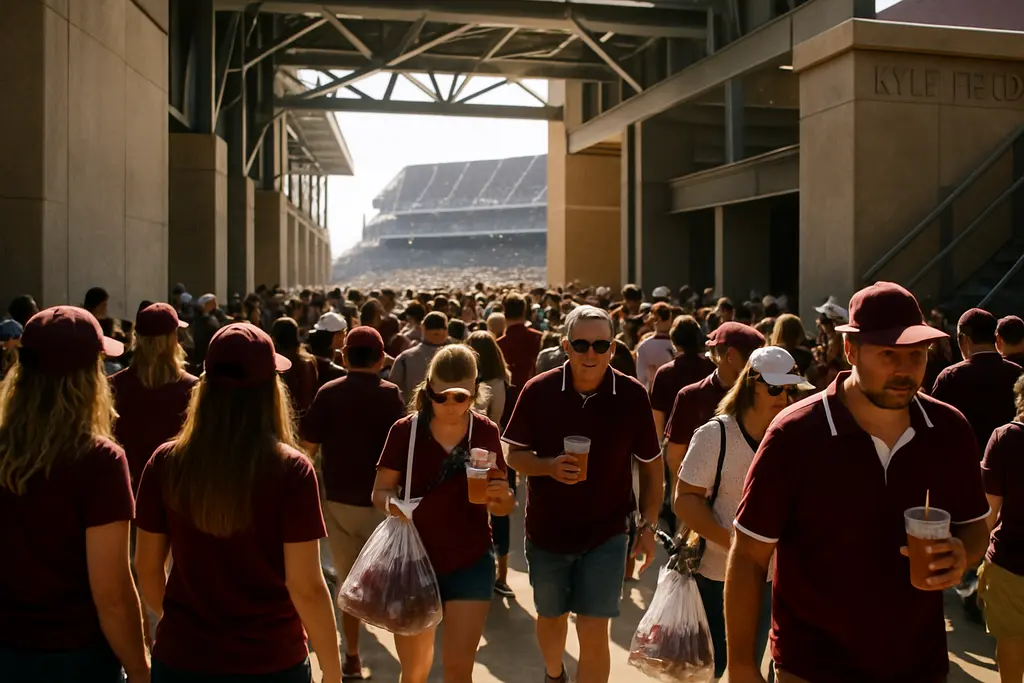

The Kyle Field passageway is not the kind of fan-experience change that shows up on a stat sheet, but anyone who has tried to move with the 12th Man from west campus tailgates toward the stadium understands why it matters. At Texas A&M, game day is a human river: families in maroon, former students walking familiar routes, students moving in packs, and first-time visitors trying to read the flow before kickoff. The new pedestrian route through the basement level of West Campus Garage gives that crowd a different way to move between Olsen Boulevard and Pickard Pass, and its value sits in the space between comfort, safety, and rhythm.
College Station does not treat football traffic as a side issue. Kyle Field hosted 107,782 fans for the September 5, 2026 season opener against Missouri State, the largest season-opening crowd in stadium history and the 12th straight game above 100,000, according to Texas A&M Athletics’ Missouri State game recap. A crowd that size turns every curb, garage entrance, shuttle stop, and plaza into part of the event. The team can win by 50 points, as the Aggies did that night, but the full memory of the day also includes how fans arrived, where they waited, and how safely they reached their seats.
What The Kyle Field Passageway Changed
Kyle Field Passageway Through WCG
Texas A&M Transportation Services added a pedestrian passageway through the basement level of West Campus Garage, connecting Olsen Boulevard and Pickard Pass. The route is open only during large events, and vehicles parked in Level B1, Row L must relocate before those events so the walking path can be used. The project also added a new pedestrian entrance at the northwest corner of the garage, expanded another entrance at the northeast corner, and reconfigured the plaza near Pickard Pass to improve access and safety, according to the official WCG event pedestrian path project page.
The details may sound practical, even plain. In a football setting, they are anything but. West Campus Garage sits in a pressure zone on game days because it is tied to parking, walking routes, tailgate movement, and the stadium pull toward Kyle Field. A garage is usually built for vehicles first. This change asks it to serve fans on foot during the busiest moments, when the campus has to act less like a normal weekday grid and more like a managed event district.
Why Separating Feet And Bumpers Matters
The central idea is simple: separate pedestrians from vehicles. Texas A&M has framed the project around reducing conflicts along John Kimbrough Boulevard, especially near garage entry and exit lanes during large events. That is a concrete safety goal, not a cosmetic stadium upgrade.
Anyone who has walked from tailgates toward Kyle Field has seen the pinch points form. One group pauses to check a phone. Another cuts across the garage approach. A vehicle waits to exit. A family with kids tries to stay together while a wave of students pushes toward the same corner. The safest design is often the one that removes the choice to mix those movements in the first place. By routing pedestrians through a marked event path, Texas A&M is trying to keep game-day energy from spilling into places where it can work against traffic flow and emergency access.
There is still an adjustment period baked into any route change. Fans build habits over years. Former students remember the way they walked as students. Tailgate groups tend to repeat the same arrival plan because it feels dependable. A new path has to earn trust not by being advertised, but by working cleanly under pressure.
How Fans Felt The Change Around Kyle Field
The Crowd Size Put It To Work
The September 5, 2026 opener gave the operation a real test because the crowd was not theoretical. More than 107,000 people came to Kyle Field, and that kind of attendance turns mobility into part of the game-day performance. When the stands are full and the sidewalks are packed, the best fan-experience upgrades are the ones that reduce friction without making themselves the center of attention.
That is where the Kyle Field passageway fits. It does not change the Aggie Band’s sound, the student section’s sway, or the pulse of the crowd before a third down. It changes the lead-up. It gives fans another defined route from a high-traffic west campus area toward Pickard Pass. It helps campus staff channel a crowd that arrives in waves rather than neat lines.
The route also speaks to a larger truth about Kyle Field: the stadium experience begins long before the ticket scan. It begins when a group decides where to park, where to meet, how early to leave a tailgate, and which side of the stadium to approach. For some fans, a smoother walk means less stress for older relatives. For parents, it can mean fewer uncomfortable moments crossing near active vehicle lanes. For students, it can mean a more direct stream into the noise they came to create.
Small Habits That Matter
The change puts some responsibility back on fans, too. Vehicles in Level B1, Row L of West Campus Garage must move before large events to clear the pedestrian path. That is not a footnote for the people who park there. It is part of the event plan, and it affects how early fans should check parking instructions before a home game.
Because the path opens only during large events, it should not be treated as an everyday campus shortcut. That distinction matters. A route that is useful on a football Saturday may not be available on a normal weekday, and fans who understand that difference are less likely to be surprised.
For a deeper look at how access changes fit into the wider football Saturday routine, the same theme carries through recent Texas A&M gameday transportation changes, where parking, shuttles, walking routes, and entry timing all shape the day before the ball is kicked.
What It Says About The 12th Man Experience

Fan Experience Is Built In The Margins
Stadiums often sell the big pieces first: video boards, premium spaces, concessions, seating, and scoreboard moments. Those are easy to see. The less visible work lives in the margins, where a fan’s day can turn from smooth to strained. A blocked walkway, a confusing garage exit, or a crossing point near moving vehicles can color the walk into one of the loudest college football venues in the country.
The Kyle Field passageway shows how Texas A&M is treating those margins as part of the event. It is a fan-experience project, but it is also an operations project. It recognizes that the 12th Man is not just a crowd inside the stadium. It is a moving body across campus, with its own timing, traditions, and pressure points.
There is no public measure in the provided official materials showing how much the route has reduced egress time or changed postgame flow. That kind of data would help sharpen the evaluation later. For now, the supported point is narrower and still meaningful: the university created a dedicated event path through West Campus Garage to reduce pedestrian and vehicle conflicts during large events.
Why The Kyle Field Passageway Matters For Aggie Saturdays
The lasting value of the Kyle Field passageway will be judged by ordinary moments. A safer crossing that no one talks about. A family staying together in a crowd. A garage exit with fewer people drifting in front of cars. A west campus tailgate crowd moving toward Pickard Pass with a little more order and a little less uncertainty.
That is not as loud as a touchdown or as visible as the War Hymn, but it belongs to the same Saturday. Texas A&M football has always been carried by people as much as players: students standing for four quarters, former students coming home, and local families building fall weekends around Kyle Field. A passageway through a garage may sound modest, yet in a place where more than 100,000 people can gather for one game, modest changes can shape how the day feels.
The best version of this project is one fans barely notice because it works. The route opens for large events, guides people away from vehicle conflict points, and lets the 12th Man save its noise for the stadium. In College Station, that is a worthy game-day win.